The Allure and the Ambush: The Global Procurement Trap
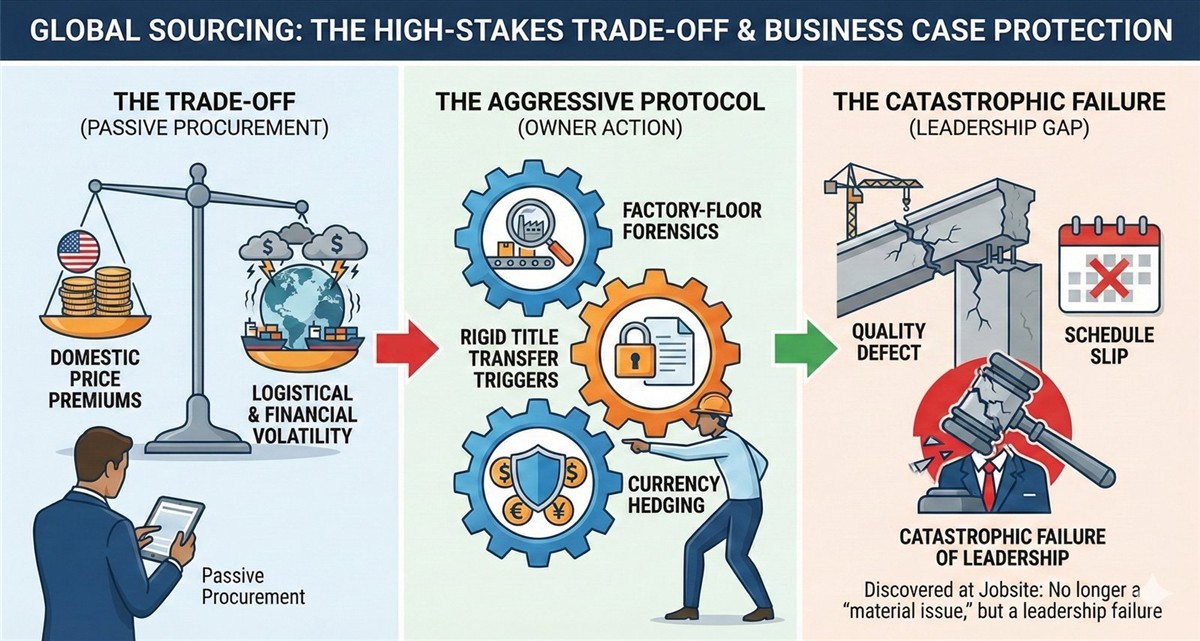
For an Owner, the siren song of global sourcing is always the same: a 20% to 30% reduction in material costs for structural steel, curtain walls, or specialized MEP components. On a billion-dollar CAPEX program, those savings are seductive. But those numbers are often a mirage that hides the "Malevolent Hiding Hand" of international logistics.
In my twenty-five years of oversight, I’ve seen projects where "cheap" Italian stone or "competitive" Chinese steel resulted in six-figure storage fees, multimillion-dollar tariff hits, and schedule delays that liquidated the original savings before the first crate was even opened. Global sourcing is not a procurement exercise; it is a risk-mitigation workstream that requires a skeptical, stoic approach to every mile of the supply chain.
Vendor Forensics: Beyond the Brochure
Prequalifying an international vendor is not about reviewing a slide deck. It is a forensic audit of their ability to survive the duration of your project. If an overseas fabricator defaults, you have zero practical recourse in their local courts. You are simply a creditor at the bottom of a very long, very foreign list.
Financial Scrutiny: Review balance sheets and capital structures. Can the vendor handle the cash flow demands of a massive export order? If they are over-leveraged, your deposit might be used to finish someone else's project.
The Resource Audit: Does the vendor actually own the fabrication facility, or are they a "broker" outsourcing the work to a shop you’ve never seen? You need to verify their technical staff and management capability in-person.
Dispute History: Investigate their litigation record. How do they handle a "non-conformance" report? If their history is litigious, expect them to hold your materials hostage the moment a Change Order (CO) is disputed.
The Legal Handover: FOB and the Transfer of Pain
International deals are fragile. The moment of "Title Transfer" is the most critical second in the procurement lifecycle. You must define exactly where the seller’s responsibility ends and your ownership begins.
Incoterms and FOB Points: Use precise "Free On Board" (FOB) points. If the contract says "FOB Port of Departure," you own those materials the moment they touch the ship. If the ship sinks or the crane drops the crate in the harbor, that’s your insurance claim, not theirs.
Currency Hedging: If you are paying in local currency (Euros, Yuan, etc.), exchange rate volatility can destroy your budget. A 5% shift in the dollar can wipe out your entire procurement "win." Contracts must include "collars" or caps on exchange rate shifts to protect the GMP.
Performance Security: Never rely on a handshake. Demand on-demand letters of credit or performance bonds from a bank with a domestic presence. If they fail to perform, you need a "pullable" fund that doesn't require five years of international arbitration to access.
Industry Term: Currency Hedging
A financial strategy used to limit or offset the risk that exchange rate fluctuations will increase the cost of a contract. This often involves "locking in" an exchange rate at the time of contract signing.
Technical Honesty in Fabrication: The Factory-Floor Proxy
Waiting for materials to arrive at the site to check quality is a sign of an amateur. If you find a bad weld or the wrong finish after the crate is on the jobsite, you’ve already lost three months of schedule.
Boots in the Shop: For critical components, place an Owner’s Representative directly inside the fabricator’s facility. They aren't there to be "partners"; they are there to provide technical oversight. They should have "stop-work" authority and the final word on QA/QC.
Testing Documentation: Require mill reports, ultrasound results, and certified test data before the item is crated. Once it's in a shipping container, the evidence of a defect is hidden under three thousand miles of ocean.
Mockups and First-Run Studies: Mandate full-size mockups for complex systems like curtain walls. Resolve the design conflicts in a controlled factory environment. It is ten times cheaper to fix a flashing detail in a shop in Istanbul than on the 40th floor of a tower in Chicago.
Aggressive Expediting: The "Out of Sight" Trap
"Out of sight, out of mind" is how global procurement dies. The Owner’s team must treat the supply chain as a live, breathing part of the critical path.
The Tracking Log as a Weapon: Maintain a centralized Management Information System (MIS) log for every shop drawing, fabrication milestone, and shipping date.
Two-Week Pulse Checks: Do not rely on "automated" status updates. Contact suppliers every 14 days. If the fabrication schedule slips by 48 hours, you need to know immediately so you can adjust the field sequence.
Just-In-Time (JIT) vs. Reality: JIT is a great theory for a textbook; it’s a nightmare for global sourcing. You need a "buffer" at a local warehouse. Shipping is imprecise. Port strikes, canal blockages, and weather happen. If you don't have the material 30 days before you need it, you don't have it.
Industry Term: FOB (Free On Board)
A standard shipping term (Incoterm) indicating the point at which the seller’s liability for the goods ends and the buyer’s begins. It defines who pays for freight and who is responsible if the goods are lost or damaged during transit.
The Strategic Backstop: Tariffs and Toxic Assets
The Owner bears the ultimate liability for global sourcing choices. The contractor might sign the purchase order, but the Owner owns the risk.
Tariff Volatility: Trade reforms can suddenly inflate the cost of imported steel or aluminum by 25% or more. Your contract must define who is responsible for "unforeseen" tariff hikes. Without clear language, the project becomes a battleground of Change Orders.
Environmental Liability: If an international vendor ships materials contaminated with hazardous substances (like lead paint or asbestos), the Owner is strictly liable for the remediation once those materials land on the site. You cannot outsource your environmental "license to operate."
Procurement Probity: Ensure all transactions follow the Foreign Corrupt Practices Act (FCPA). A "kickback" at a foreign port might get your materials moved faster, but it can trigger a federal investigation that shuts down your entire organization.
“So What?”: Why Global Sourcing Demands Executive Presence
Financial Impact: Global sourcing is often a "False Economy" if not managed. The 20% savings on material is easily eclipsed by 10% in shipping, 5% in tariffs, and the "Impact Costs" of a 60-day schedule delay.
Schedule Risk: The supply chain is the critical path. A single missing custom bracket from an overseas vendor can stop a $100M façade installation.
Personnel Implications: Global sourcing requires a specialized "Procurement & Logistics" team. Do not expect your standard PM to manage an international shipping manifest between their OAC meetings.
Strategic Consequences: An asset built with un-vetted international components has a higher Total Cost of Ownership (TCO). If you can't find replacement parts domestically in ten years, the "cheap" international win was a strategic loss.
The Bottom Line
Global sourcing is a test of an Owner's technical grit. It requires you to be skeptical of "deals," aggressive with oversight, and stoic regarding the inevitable volatility of the international market.
If the math doesn't mirror the mud, it’s usually because someone forgot that a cheap price in a different time zone still has to survive the reality of the ocean. Control the factory, own the title, and track the crate. Otherwise, your "cost-saving" material is just a very expensive piece of driftwood.
Actionable Strategy for Owners:
Audit the Incoterms: Review every international PO. If it says "FOB Origin," make sure your insurance carrier knows you own that risk the second it leaves the factory.
Mandate Factory Inspections: Budget for travel and third-party QA. It is a mandatory insurance premium on the project’s health.
Calculate the "True Landed Cost": Don't look at the unit price. Demand a report showing the unit price + freight + insurance + tariffs + storage + 10% "volatility buffer." That is your real number.
Establish a Logistics Liaison: Assign one person whose only job is to track the Bill of Lading and the port status. "I’ll check on it next week" is a phrase that leads to litigation.