BLUF (Bottom Line Up Front):
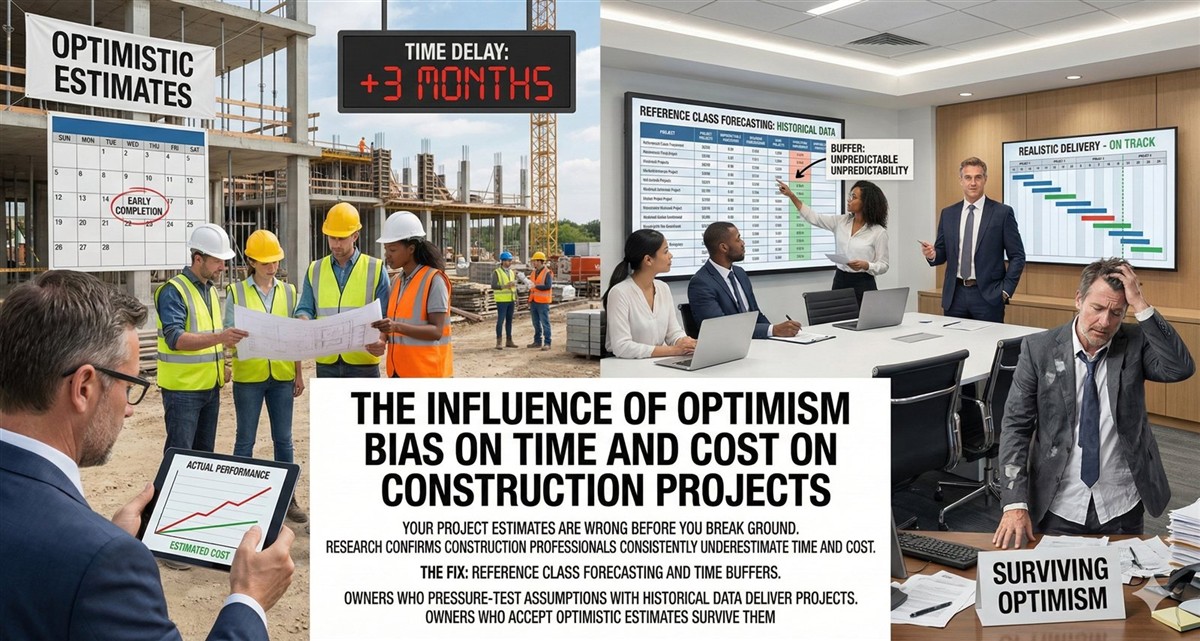
Your project estimates are wrong before you break ground—not because your team is incompetent, but because they're human. Research confirms that construction professionals exhibit moderate optimism bias across the board, consistently underestimating time and cost while remaining unaware they're doing it. The fix isn't better spreadsheets. It's reference class forecasting—estimating based on how similar projects actually performed—and building time buffers that account for the predictable unpredictability of construction. Owners who pressure-test assumptions with historical data deliver projects. Owners who accept optimistic estimates survive them.
The Influence of Optimism Bias on Time and Cost on Construction Projects - Summary
Chadee, A. et al. 2021. The Influence of Optimism Bias on Time and Cost on Construction Projects. Emerging Science Journal. 5, 4 (Aug. 2021), 429–442. DOI:https://doi.org/10.28991/esj-2021-01287.
From <https://ijournalse.org/index.php/ESJ/article/view/594>
Why Your Team Keeps Underestimating Projects (And How to Fix It)
Every owner has watched it happen. The estimate looked solid. The schedule seemed reasonable. Six months later, you're staring at a cost report that bears no resemblance to the original budget and a completion date that's drifted into next year.
The easy explanation is bad estimating or scope creep. But a research study out of Trinidad and Tobago points to something harder to fix: the people making your estimates are psychologically wired to be wrong.
The Problem Isn't Incompetence—It's Human Nature
The study, "The Influence of Optimism Bias on Time and Cost on Construction Projects," examined how construction professionals consistently underestimate time and cost. Not because they're lazy or unqualified. Because they're human.
Optimism bias is the tendency to assume things will go better than history suggests. It's not hope. It's a cognitive blind spot. And it's expensive.
The researchers measured bias levels across project teams and found moderate optimism bias was nearly universal. Worse, most participants had no idea they were doing it. They were confident in estimates that experience should have told them were unreliable.
Where the Blind Spots Live
The study identified three areas where optimism runs hottest:
Project location. Teams consistently underestimate site-related problems—access issues, soil conditions, utility conflicts. The assumption is always that conditions will be manageable. They rarely are.
Environmental and historic preservation. Regulatory timelines get compressed in early estimates. Permitting agencies don't move faster because your schedule needs them to. Historic review boards don't care about your financing deadlines.
Labor disputes. The belief that workforce issues won't materialize—or will resolve quickly—is almost universal. It's also almost always wrong when it matters most.
These aren't obscure risks. They're the same categories that blow up projects year after year. And yet, teams keep underestimating them.
Two Tools That Actually Work
The researchers propose two countermeasures. Neither is complicated. Both require discipline.
Reference class forecasting means estimating based on how similar projects actually performed—not how you hope this one will go. Pull data from your last five comparable projects. Look at real durations, real costs, real contingency burn rates. That's your baseline. Not the number that makes the pro forma work.
Built-in time buffers accept that optimism bias isn't going away. You're not going to train it out of your team. Instead, you build contingency windows into the schedule that account for the predictable unpredictability of construction. This isn't padding—it's realism.
Why This Matters to Owners
Optimism bias doesn't show up in your risk register. It doesn't get flagged in a constructability review. It lives in the assumptions underneath every estimate your team produces.
Left unchecked, it erodes contingency before you break ground. It compresses schedules that were already tight. It creates the conditions for the scope fights, change order battles, and completion delays that turn a good project into a painful one.
This study is one of the first to formally quantify the problem. That matters because you can't manage what you can't see. Once you understand that your team's estimates are structurally biased toward optimism, you can start adjusting for it.
The Simple Version
Think about the last time you estimated how long a task would take—any task. You probably pictured everything going smoothly. No interruptions. No surprises. No rework.
That's optimism bias.
Now think about how that task actually went.
The gap between those two versions is what's buried in every estimate on your project. Reference class forecasting closes that gap by forcing you to plan based on what actually happens—not what you hope will happen.
Your estimates will look less aggressive. Your schedules will have more float. Your contingency will last longer. And you'll stop being surprised by outcomes that were predictable all along.