As someone looking closely at the intersection of technology and industry, I see two massive shifts coming forward:
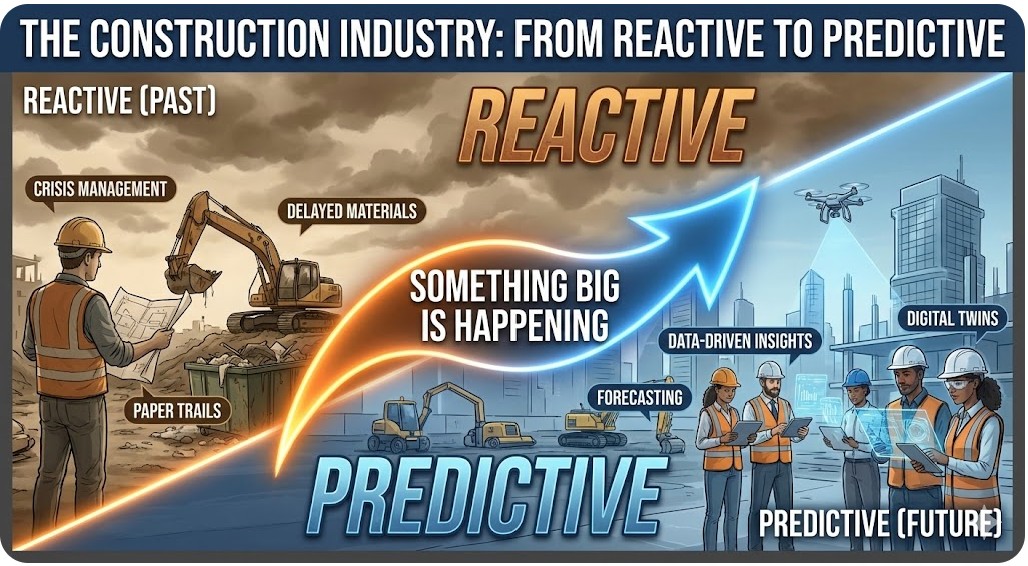
1. The Construction Industry: From Reactive to Predictive
In construction, we’ve always been at the mercy of "lagging indicators"—discovering a delay or a budget overrun only after it has happened.
The Shift: We are moving toward autonomous project management. Imagine AI agents that don’t just flag a risk but autonomously recalculate schedules, coordinate with suppliers, and simulate thousands of design-build alternatives to find the one with the lowest carbon footprint and highest safety rating—all before a single shovel hits the ground.
The Reality: As Shumer notes, "physical presence" is a shield for now, but the cognitive work behind the build (estimating, scheduling, and site safety analytics) is being rewritten as we speak.
2. The Future of Education: From Content Delivery to Interpretation
Shumer’s essay highlights a terrifying/exciting truth: If AI can do the work of a PhD, what are we teaching our kids?
The Shift: Education can no longer be about "knowing things." It must be about agency and judgment.
The Reality: We are moving toward a "Future-Fluid" model. Students need to learn how to lead AI agents, audit their "taste," and navigate a world where the technical barriers to building anything—an app, a business, a building—have vanished (real talk: I'm currently working on all three).
My Takeaway: The "window of advantage" is small. As Matt says, the person who uses AI to do a week’s worth of analysis in an hour is the most valuable person in the room—but only until everyone else catches up.
Are we preparing our teams and our students for the "shockwave," or are we still planning trips for March 2020?
I’d love to hear from my network—especially those in AEC and EdTech. How are you "leaning into what’s hardest to replace" right now?