The Absent Owner Problem
Every project begins as a promise—a financial thesis translated into a vision. Too often, Owners assume that hiring "the best" talent is enough to guarantee an outcome. They view their role as a patron who writes checks and awaits a flawless performance.
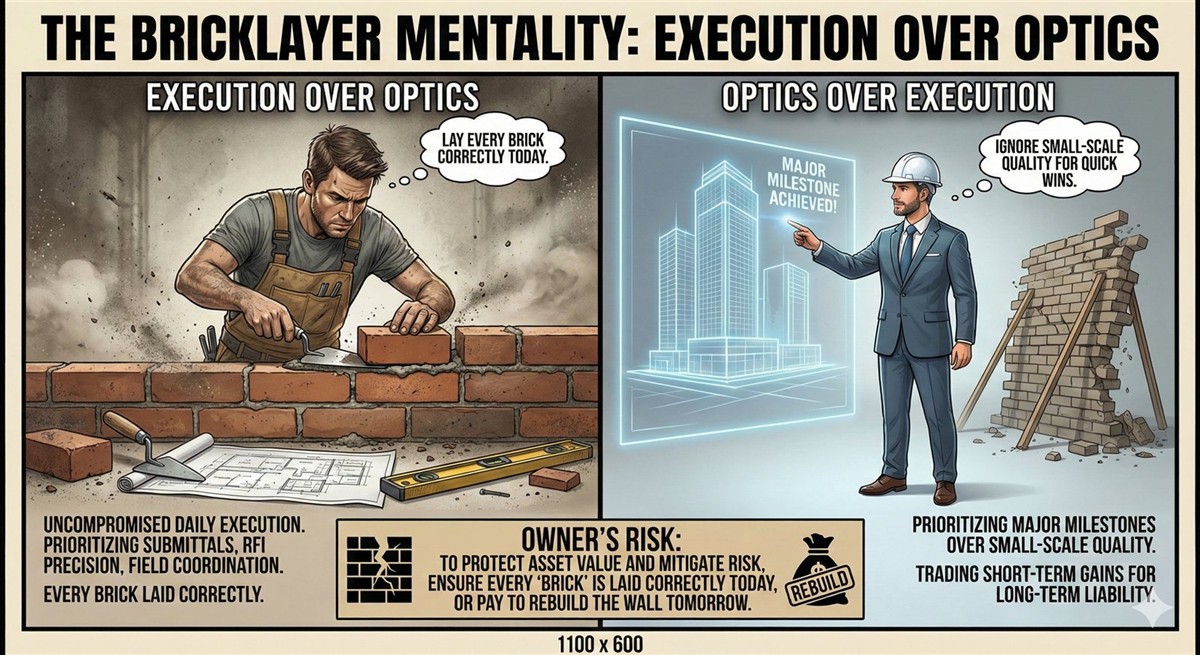
This is a dangerous misunderstanding of construction physics. A project left to its own devices will naturally drift toward chaos, scope creep, and schedule decay. Consider the project as a symphony: the Designer is the composer, the Contractors are the musicians, and the Construction Manager (CM) is the conductor. Without the Owner acting as an active, engaged patron who demands precision and sets clear boundaries, the "musicians" will eventually play out of tune. Success requires a commitment to the principle of "Think Slow, Act Fast"—investing heavily in the friction of pre-construction to ensure a frictionless execution.
The Fiduciary Ecosystem: Defining the Players
A project is only as stable as the boundaries established at its inception. Understanding the distinct roles and liabilities of the core team is the first step in risk mitigation.
The Owner as Defender: The Owner’s primary responsibility is defending the investment thesis. This means establishing the non-negotiable parameters for cost, quality, and schedule before the first shovel hits the dirt.
The CM as the Insurance Policy: The Construction Manager (CM) or Program Manager (PgM) acts as the Owner’s fiduciary agent. Their role is to apply professional discipline to manage the "Big Three": time, cost, and scope. They are the frontline defense against the budget overruns that sink a pro forma.
The Designer as Technical Authority: The Designer carries professional liability for the technical integrity of the project. While they provide the creative engine, their relationship with the CM must be one of collaborative pragmatism—balancing aesthetic aspiration with the hard reality of constructability.
The Contractor as Executioner: The Contractor owns the means, methods, and sequencing of the build. While they control the "how," they bear ultimate accountability for site safety and installation quality.
The Project Constitution: Governance Over Guesswork
Project paralysis is almost always caused by murky authority. To prevent conflict, the Owner must implement a rigid infrastructure of accountability.
The RACI Matrix: A documented Responsibility Assignment Matrix (RACI) identifies exactly who is Responsible, Accountable, Consulted, and Informed for every significant task. This kills the "he-said, she-said" culture that thrives in the absence of clear decision rights.
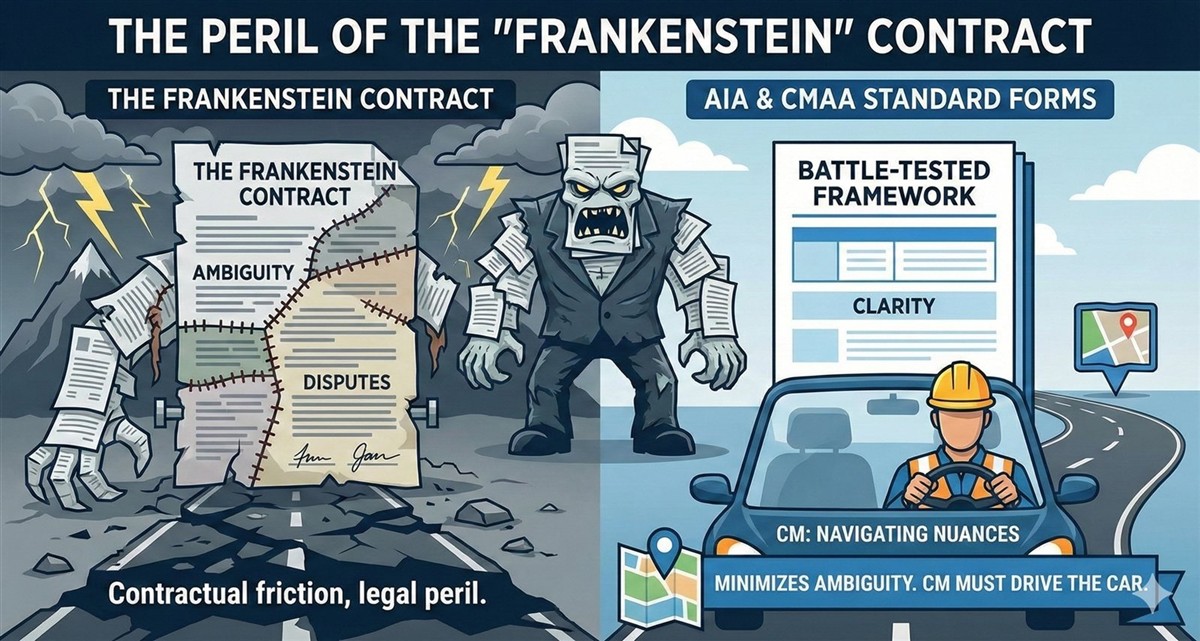
PMP and PPM: The Project Management Plan (PMP) and Project Procedures Manual (PPM) serve as the project’s constitution. These documents transform implicit expectations into explicit commitments. If it isn't in the manual, it doesn't exist.
The Extended Network: Strategic leadership extends to managing "un-contracted" stakeholders—lenders, regulatory bodies, and the public. Early engagement with these groups is essential to maintaining the "social license to operate" and avoiding political delays that no contractor can mitigate.
Technical Honesty: The Single Source of Truth
Disputes over project status are usually just disputes over data. When the field and the boardroom are looking at different numbers, the project is in trouble.
BIM and MIS Integration: Leveraging Building Information Modeling (BIM) and integrated Management Information Systems (MIS) provides real-time visibility into design evolution and budget health.
Data-Driven Decisions: When all stakeholders access the same data, decision-making accelerates. Transparency isn't about exposing mistakes; it’s about identifying trends early enough to deploy resources before a problem becomes a crisis.
Professional Composure: Stakeholder management requires unwavering stoicism. Emotional outbursts or unprofessional conduct poison relationships and derail negotiations. An Owner must demand ethical stewardship and professional code-of-conduct adherence from every consultant on the payroll.
Decisive Stewardship: The Courage to Reset
Strategic leadership occasionally requires making the most difficult call: termination. If a design team consistently delivers over-budget solutions or a stakeholder refuses to cooperate on essential value engineering, the Owner must be prepared to reset the team dynamic. Protecting the project’s fundamental viability is a higher priority than maintaining a failing relationship.
“So What?”: Why Strategic Leadership Matters
Financial Impact: Active leadership prevents the "death by a thousand cuts" caused by unmanaged scope creep and administrative drag.
Schedule Risk: Clear governance and early stakeholder engagement mitigate the regulatory and political "pinch points" that derail timelines.
Personnel Implications: A culture of collaborative respect attracts "A-Team" talent who want to work in an environment where problems are solved rather than litigated.
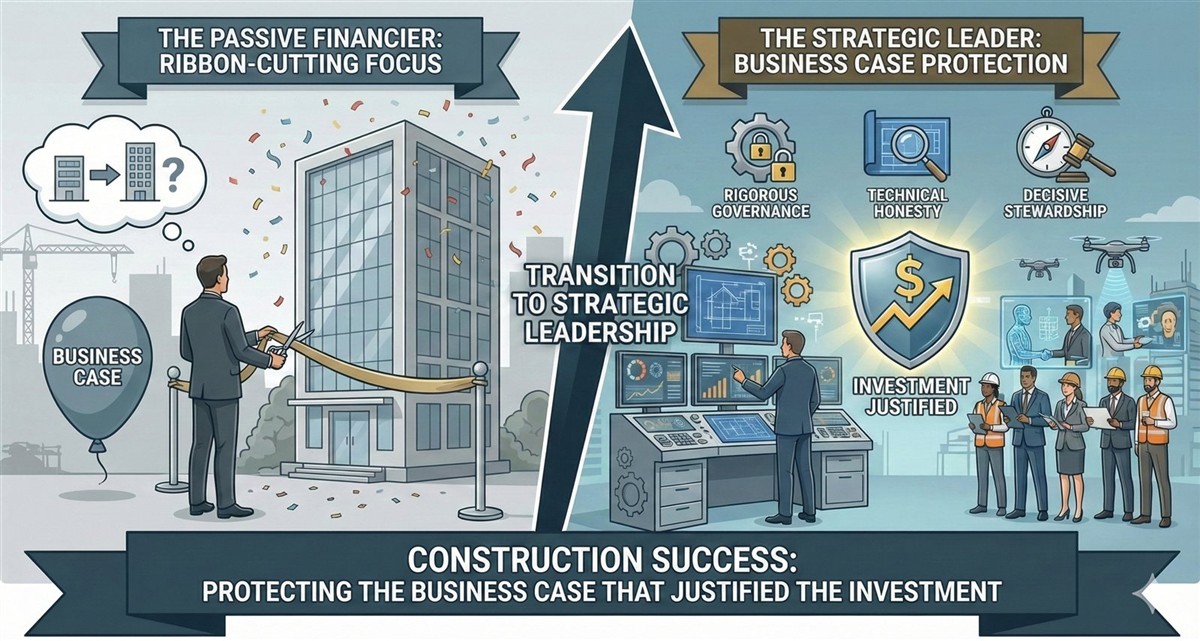
Asset Performance: Strategic oversight ensures the final building meets the functional excellence required to deliver the long-term ROI promised in the original business case.
The Bottom Line
The Owner's role transcends writing checks. Effective Owners function as strategic leaders who assemble the right "orchestra," establish the "score" through clear governance, and make the tough decisions necessary to protect the capital.
The result is not just a completed building, but a successful investment that delivers lasting value. If you don't manage the symphony, the noise will eventually drown out your profit.
Actionable Strategy for Owners:
Audit the Governance: Review your PPM. If it doesn't clearly define change order protocols and decision rights, it’s not protecting you.
Verify the CM's Ethics: Ensure your representatives adhere to a professional code (like the CMAA Code of Ethics) that prioritizes your interests above their own fee.
Walk the Model: Use BIM as a management tool, not a design toy. If you aren't seeing the design evolution in the 3D environment, you aren't seeing the whole truth.
Enforce the RACI: The next time a decision is delayed, ask who was "Accountable" on the RACI. If no one can answer, you have a governance gap.