The Peril of the "Frankenstein" Contract
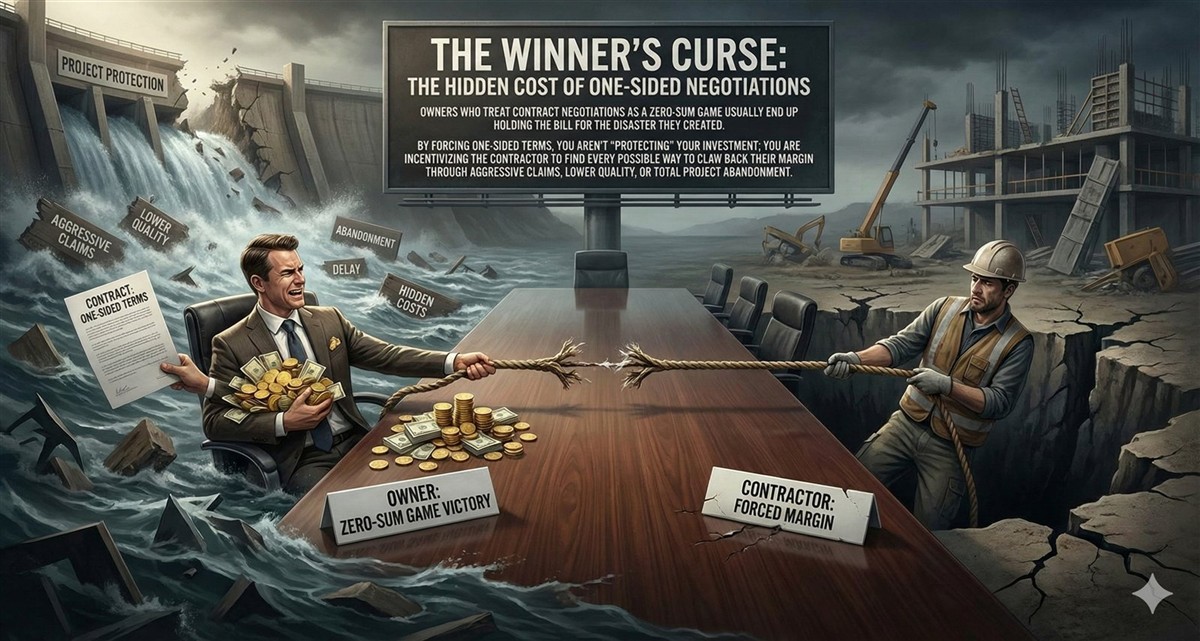
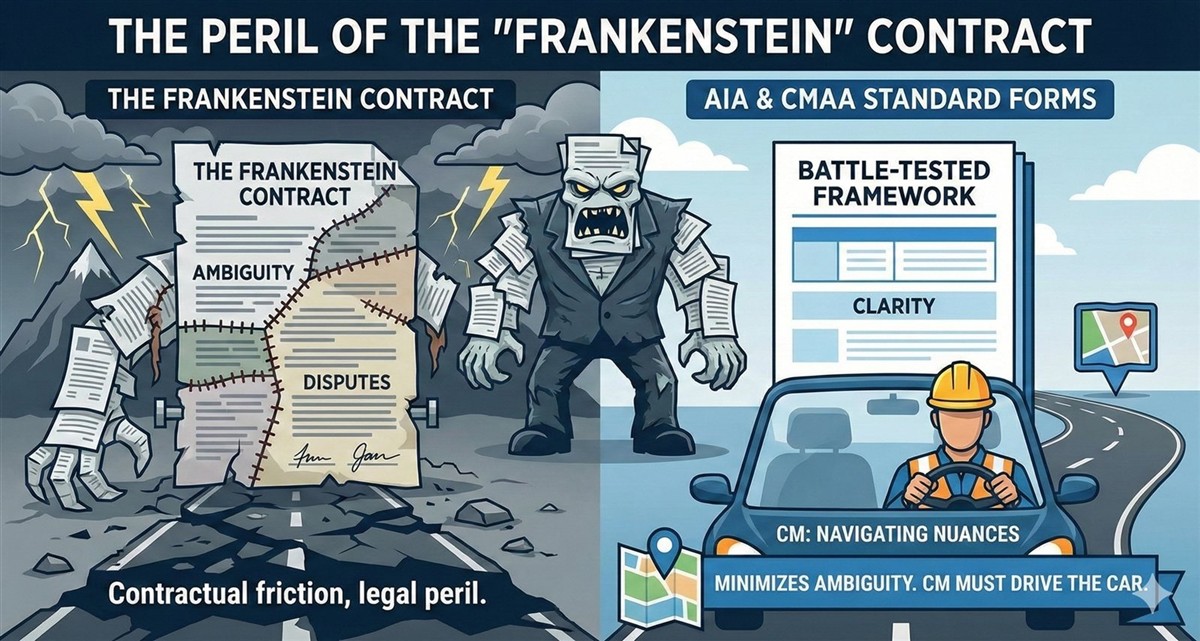
The most expensive disputes in capital construction rarely stem from technical field failures. They stem from "bespoke" contracts—documents hand-crafted by attorneys who have never managed a trade handover. These "Frankenstein" agreements are often stitched together with aggressive, one-sided clauses designed to shift every ounce of risk onto the contractor.
The result is never a "protected" Owner. The result is a project that starts in a defensive crouch. When an agreement is unfamiliar and predatory, the contractor prices in an "uncertainty tax," and the field team spends more time documenting claims than hitting milestones. Standard forms like the AIA A-Series and CMAA A-Series offer a different path: predictability.
The Value of Battle-Tested Language
The primary benefit of an AIA or CMAA form is that its definitions have been vetted in the court system for decades. When the AIA A201 (General Conditions) defines "Substantial Completion," or a CMAA A-1 outlines the "Construction Manager’s Scope of Services," the industry knows exactly what those words mean.
Eliminating Ambiguity: Disputes live in the gaps between definitions. Standard forms close these gaps by using industry-recognized terminology. The trades know what is expected, the Architect understands their limits, and the Owner knows their fiduciary obligations.
Balanced Risk Allocation: Standard forms are generally perceived as fair. They allocate risk to the party best positioned to manage it. When a contract is balanced, the adversarial temperature of the project drops. A collaborative environment is not a "soft" goal; it is a strategic requirement for maintaining schedule integrity and protecting the business case.
The CM as the Technical Navigator
An Owner should never mistake the presence of a standard form for the management of one. Construction Managers must be well-versed in the nuances of contract language, insurance requirements, and safety regulations that these forms standardize.
Insurance and Indemnity: Standard forms provide a structured framework for insurance, but the CM must ensure the actual policies in the field match the contract mandates. A "standard" clause is useless if the CM misses a lapsed umbrella policy or a missing "Additional Insured" endorsement on a $50M project.
Safety and Regulations: Established contract forms integrate OSHA and local safety compliance into the performance requirements. The CM’s role is to ensure "contractual safety" translates into "site safety." A single safety incident can trigger a chain of litigation that no contract—standard or otherwise—can fully insulate the Owner from.
The Limits of Standardization: Why Disputes Persist
Standard forms reduce the potential for disputes, but they do not eliminate it. The form is a baseline, not a guarantee.
The Problem of Custom Riders: Owners often "improve" standard forms by adding dozens of custom riders and "supplementary conditions." This is where the trouble begins. Grafting aggressive, bespoke language onto a balanced AIA or CMAA form creates internal contradictions. These contradictions are the primary breeding ground for Change Orders and legal claims.
Administrative Failure: A standard contract requires standard administration. If the contract mandates a 7-day notice for a delay (a common AIA/CMAA requirement), but the CM ignores that for six months, the Owner has effectively waived their protection. The "standard form" will not save an Owner from "waiver by conduct."
“So What?”: Why Contract Standards Matter to the Bottom Line
Financial Impact: Utilizing established standards reduces "legal friction" costs. Using pre-vetted AIA or CMAA agreements saves tens of thousands in upfront legal drafting fees and millions in potential litigation costs.
Schedule Risk: Familiarity breeds speed. When the project team understands the "Notice" and "Claim" procedures of a standard form, decisions happen faster. Delayed decisions are the leading cause of schedule slippage.
Personnel Implications: High-performing teams prefer standard agreements. It signals that the Owner is a "Professional Owner" who values technical grit over contractual gamesmanship.
Strategic Consequences: An asset built under a clean, standard contractual record is easier to sell, easier to refinance, and significantly easier to audit for long-term asset value.
The Bottom Line
Standard forms of agreement are not a "set-it-and-forget-it" solution. They are a high-performance tool that requires a skilled operator. If an Owner utilizes an AIA or CMAA standard form but hires a CM who lacks the technical fluency to manage the insurance nuances or the administrative triggers, they are simply buying an expensive seat to a future lawsuit.
Use the standards. Respect the language. But ensure the Construction Manager has the expertise to manage the reality that the contract describes.
Actionable Strategy for Owners:
Adopt AIA/CMAA Standards: Make standard formats the default for your CAPEX program.
Audit the "Riders": If the legal team wants to add 50 pages of supplementary conditions to a standard form, demand they justify the "Risk vs. Friction" cost of every line.
Vetting the CM: During the RFP process, ask prospective CMs to explain the "Change Order" and "Dispute Resolution" logic of the AIA A201 or the CMAA A-1. If they can’t explain the logic, they can’t protect your budget.
Don't "Frankenstein" the Form: If a definition is changed in one section, it ripples through the document. Keep the standard language intact whenever possible to maintain technical honesty.