The Bricklayer Mentality: Execution Over Optics
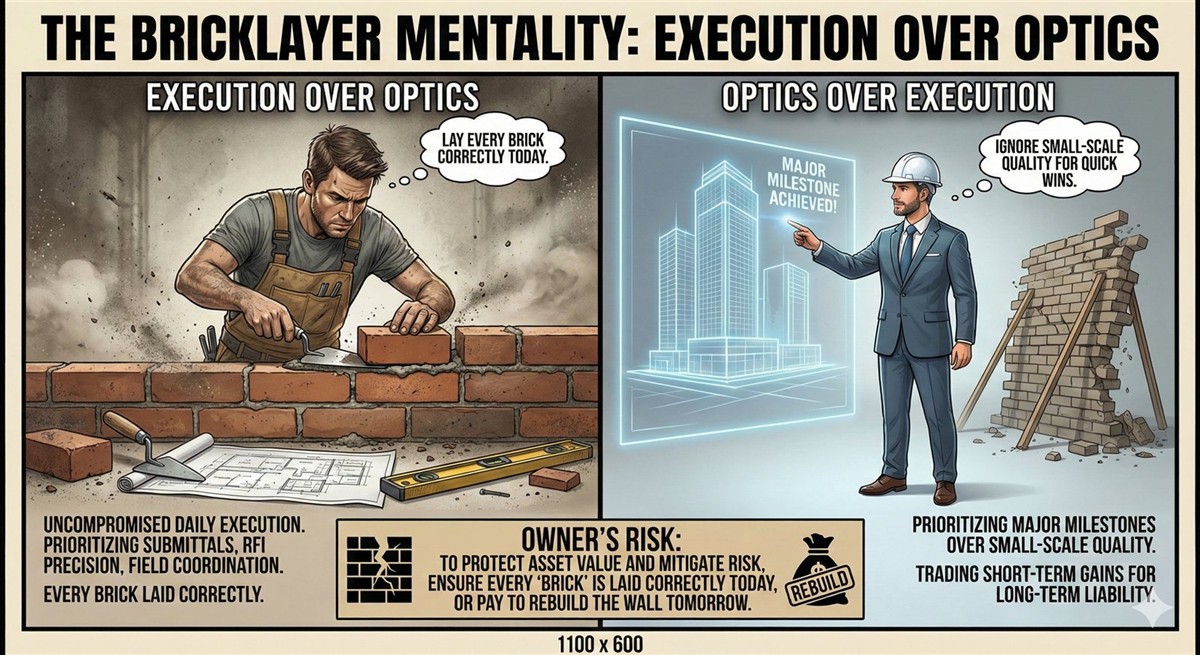
Project failure is rarely the result of a single, catastrophic event. It is the cumulative result of a thousand small, overlooked details. While executive boards and developers obsess over 30,000-foot milestones and "visionary" project renderings, the actual health of a capital program is determined in the mud, one submittal, one inspection, and one brick at a time.
Management often forgets that a $500M asset is just a massive collection of individual tasks. When the focus shifts too far toward the "wall" and away from the "brick," the project is already in jeopardy.
The Macro Delusion
There is a common trap in senior leadership: managing by dashboard. If the schedule software shows green, the assumption is that the project is healthy. This is a fallacy.
A project can be on schedule while simultaneously building in massive future liabilities. If the quality of the daily "bricks"—the concrete pours, the flashing details, the MEP coordination—is substandard, the schedule won't matter. The time gained today will be lost threefold during commissioning, punch lists, and the inevitable litigation that follows a latent defect.
The High Cost of the "Big Picture"
When teams focus only on the finished product, they develop a tolerance for "good enough" in the short term. This manifests in several ways:
Deferred Coordination: Pushing MEP clashes "to the field" because the design schedule is tight.
Pencil-Whipping Inspections: Signing off on work-in-place to hit a billing cycle.
Scope Gaps: Ignoring minor overlaps between trades that eventually become six-figure change orders.
In the Owner’s perspective, a "brick" laid poorly today is a liability on the balance sheet tomorrow.
The Discipline of the Daily Task
The "Bricklayer Mentality" is not about motivation; it is about Standard of Care. It is the rigorous, almost boring commitment to ensuring every individual component of the project meets the specifications.
Identify the Daily "Brick": For an Owner’s Rep, this is the RFI response time, the change order review, or the site walk. It is the one task that, if done perfectly today, prevents a compounding error tomorrow.
Eliminate the "Close Enough" Culture: A brick that is slightly out of plumb is an aesthetic issue; a project team that accepts slightly out-of-spec work is a systemic risk.
Trust the Process, Verify the Outcome: Trusting a General Contractor is necessary; verifying their daily quality control (QC) is mandatory. The wall only stands if the Owner ensures the mortar is mixed correctly every single morning.
So What?
The financial and operational implications of ignoring the "bricks" are concrete:
| Factor | Impact of Poor Execution | Long-Term Consequence |
|---|---|---|
| Financial | Rework costs typically run 2x–3x the original cost. | Erosion of project contingency and ROI. |
| Schedule | Small daily slips (15 mins here, an hour there) lead to months of delay. | Liquidated damages and missed market windows. |
| Asset Value | Poorly executed envelopes lead to water intrusion. | Massive TCO (Total Cost of Ownership) spikes. |
| Personnel | Sloppy standards lead to low morale and high turnover. | Loss of institutional knowledge mid-build. |
The Bottom Line
An extraordinary project is simply an ordinary project where the basics were never ignored. Stop staring at the renderings and start looking at the submittals. If the daily bricks are laid perfectly, the wall takes care of itself. If they aren't, no amount of "big picture" thinking will keep the roof from leaking.
Don’t build a legacy. Just lay the next brick correctly.