The Anatomy of a "Double Whammy"
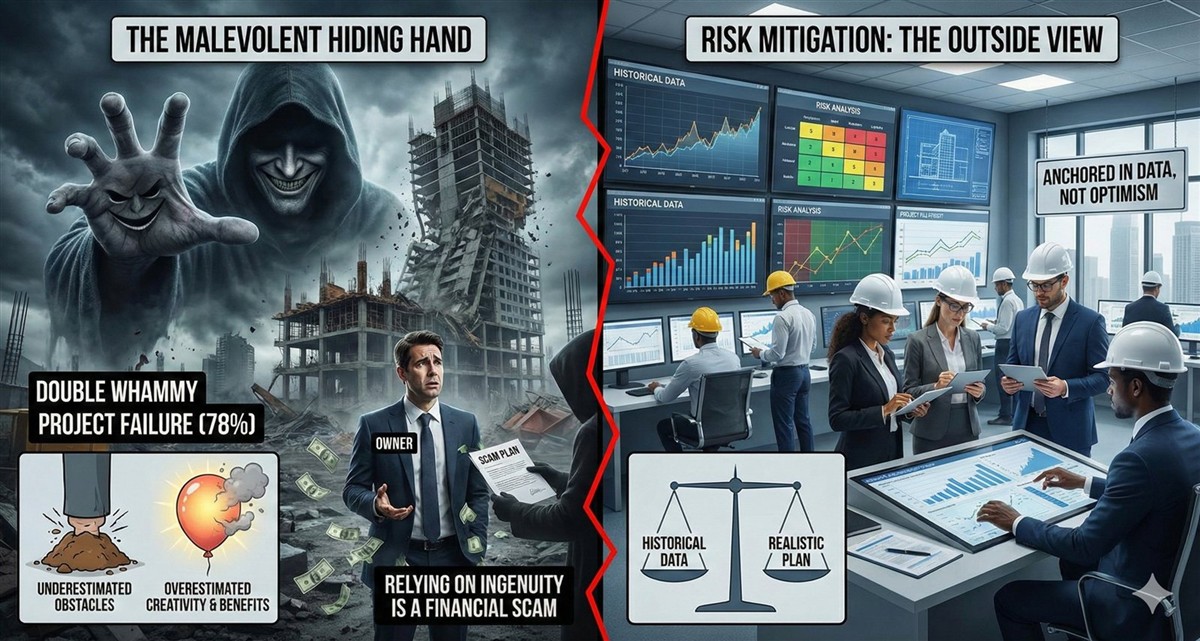
In the boardroom, every project begins with a sense of providential optimism. There is a common psychological trap known as the "Benevolent Hiding Hand," which suggests that even if we underestimate the obstacles of a project, our own latent creativity will emerge to solve them.
The reality is far darker. In nearly 80% of major projects, the "Malevolent Hiding Hand" takes hold. This is the functional opposite of hope. It hides the barriers to creativity itself, ensuring that problem-solving abilities never materialize to meet escalating costs. While planners are busy underestimating CAPEX, they are simultaneously inflating the project's utility and benefits. The result is a "Double Whammy": a project that costs 50–200% more than planned but delivers only a fraction of its promised value.
The Mechanics of Ignorance: Why Creativity Fails
The Malevolent Hiding Hand thrives on the "planning fallacy writ large." It isn't just about a missed schedule; it is about a fundamental disconnect from reality.
The Ignorance Trap: Planners assume that field crews will "figure it out" when a design conflict arises. But the Malevolent Hiding Hand ensures that by the time the conflict is discovered, the budget is depleted, and the technical debt is too high to allow for creative solutions.
The Benefit-Cost Shortfall: Statistical analysis of over 2,000 projects confirms that the benefit-cost ratio is typically overestimated by up to 200%. This is particularly prevalent in high-risk sectors like rail, dams, and tunnels, where the "unknown unknowns" are most lethal.
Toxic Optimism: The assumption that human ingenuity is "providential" is a dead end. Relying on "faith" in later creativity is a dereliction of fiduciary duty.
Pseudo-Comprehensive Planning: The Marketing Trap
Often, the Hiding Hand is activated by calculated power moves designed to secure funding rather than ensure project health. Advocates use "strategic misrepresentation" to make their projects appear superior during budget competitions.
The "Pseudo-Imitation" Technique: Planners pretend a project is a simple copy of a previous success. They ignore unique site constraints, local codes, and supply chain volatility, presenting the job as "standard" to lure the Owner into a false sense of security.
Pseudo-Comprehensive Programs: Decision-makers are often seduced by 2,000-line schedules and massive BIM models that give the illusion that experts have found all the answers. These programs often stifle real imagination by masking ignorance with complexity.
The Naked Emperor Phenomenon: Once a project is approved based on these fictional benchmarks, no stakeholder is willing to acknowledge the obvious uncertainty. The team enters a "conspiracy of optimism" to protect their own reputations while the project’s business case bleeds out.
Power Plays and Moral Hazard
When the Hiding Hand is at work, there is often a "moral hazard" where the people forecasting the risks are not the ones who will pay for the failures.
Funding Securitization: Advocates underplay risks to get the "go" decision, knowing that once the concrete is poured, the Owner is "captured" and will be forced to fund the overruns.
Misaligned Incentives: Consultants and planners are often paid to deliver a "favorable" forecast, not an accurate one. This creates an environment where technical forecasting is subservient to political motivation.
The Defensive Strategy: Anchoring in the "Outside View"
To kill the Malevolent Hiding Hand, the Owner must separate technical forecasting from political influence. This requires a transition from internal guesswork to an "Outside View."
Independent Scrutiny: Accountability is only possible through external scrutiny by independent experts who have no stake in the project’s approval. Their job is to challenge the "pseudo" planning methods and expose the gaps in logic.
Comparative Anchoring: Owners must demand that budgets and schedules be anchored in comparative data from similar historical projects. If 80% of similar projects saw a 40% cost overrun, your internal "best-case" estimate is irrelevant.
Technical Truth: Risk mitigation requires unbiased analysis. If the math doesn't mirror the historical mud of similar builds, the plan is a work of fiction.
“So What?”: The Business Impact of Hiding Hands
Financial Impact: MHH leads to "Double Optimism" where higher-than-estimated construction costs meet severe shortfalls in actual project utility. This is how assets become "White Elephants."
Schedule Risk: Relying on field-level "creativity" to solve design gaps creates unmanaged delays. Once the rhythm of the project is lost to these "surprises," it stays lost.
Personnel Implications: Teams operating under MHH are under constant, emergency-level stress. This burns out talent and leads to the "B-Team" finishing the build.
Strategic Consequences: For an Owner, the MHH doesn't just damage one project; it can threaten the liquidity and reputation of the entire organization.
The Bottom Line
The Benevolent Hiding Hand—where ingenuity saves the day—is a rare exception occurring in only 22% of cases. The Malevolent Hiding Hand is the rule.
If your project team tells you "don't worry, we'll solve the details in the field," they are inviting the Hiding Hand to your balance sheet. Hope is not a management strategy. Use the "Outside View," demand independent scrutiny, and remember: if the project looks too perfect on paper, the obstacles are likely just hiding.
Actionable Strategy for Owners:
Mandate the Outside View: Require a "Reference Class Forecast" that anchors your budget in actual data from at least 10 similar projects.
Audit for "Pseudo" Planning: Look for "pinned" dates in the schedule and "lump sum" allowances in the contingency. These are the hiding spots for obstacles.
Separate Forecasters from Advocates: Ensure the people who approve the budget are not the same people who designed the project.
Challenge the "Copy-Paste": If a consultant tells you this is "just like the last one," make them prove it by detailing the unique site risks they've supposedly already mitigated.