The Tip of the Iceberg: The Direct Cost Mirage
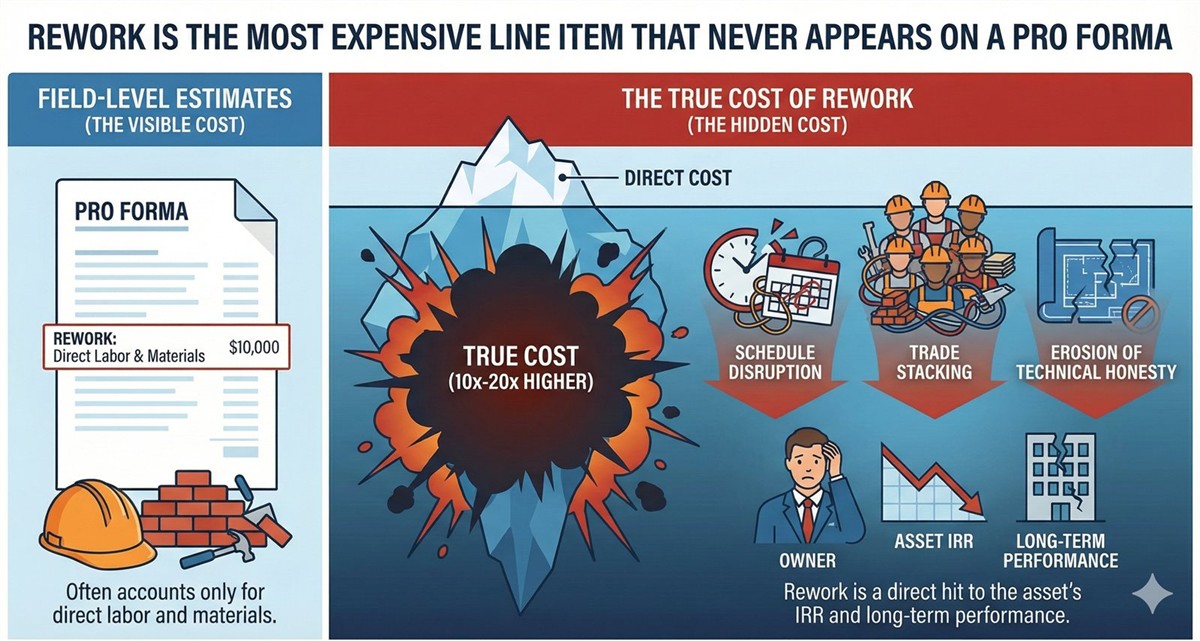
In construction, there is a dangerous tendency to view rework as a simple matter of "remove and replace." If a pipe is installed in the wrong location, the internal logic suggests the cost is merely the price of a new pipe and the labor hours to move it.
This is a Mirage. Direct costs—the labor and materials—represent less than 20% of the actual impact. The true cost of rework is found in the "Technical Debt" it creates. When a task is performed incorrectly, the project doesn't just stop; it moves forward on top of a mistake. Fixing that mistake later requires "unwinding" the work of three or four other trades who followed the error. In high-altitude capital programs like data centers or hospitals, the cost of "unwinding" one day of work can equal ten days of progress.
The Momentum Killer: Indirect Costs and Trade Stacking
Construction is a game of momentum. Every project has a "cadence" or a rhythm. Rework is a cardiac arrest in that rhythm.
Trade Stacking: When a trade has to return to an area they’ve already "completed," they compete for space with the trade currently assigned to that zone. This is trade stacking. Productivity for both crews drops by as much as 30–50%. The Owner pays for this in "Impact Costs" that are often hidden in the contractor's next "emergency" change order.
Management Bandwidth: Rework siphons the most valuable resource on the jobsite: the attention of the senior staff. Instead of looking ahead at the next milestone, the Superintendent and Project Manager are stuck in a "post-mortem" in the trailer, debating how to fix a past failure.
The Procurement Domino Effect: On complex builds, rework often reveals that a long-lead item was ordered based on a flawed assumption. If a specialized chiller or switchgear doesn't fit because of field errors, the re-procurement time is measured in months, not days.
The "Conspiracy of Silence" and Quality Erosion
Rework has a psychological cost that is rarely audited. When a project becomes a series of "fix-it" loops, the team culture shifts from "doing it right" to "getting it done."
Defect Normalization: Once rework becomes common, the standard for quality drops. The team begins to accept "close enough," leading to an accumulation of minor defects that don't trigger immediate rework but devastate the asset’s Total Cost of Ownership (TCO).
The Litigation Pathway: Rework is the primary breeding ground for claims. Every hour spent fixing a mistake is an hour someone feels they shouldn't have to pay for. This creates an adversarial environment where the "Single Source of Truth" is replaced by a "He-Said, She-Said" blame game.
The Owner’s Liability: Financing and Revenue Windows
For the Owner, the true cost of rework is ultimately a financial calculation centered on time.
Financing Costs: Most capital projects are built on debt. A two-month delay caused by cascading rework is two months of additional interest payments with zero offsetting revenue. For a multi-billion dollar program, interest carry can exceed $100,000 per day.
The Revenue Window: In sectors like retail, energy, or healthcare, the opening date is often tied to a specific market window. Missing that window doesn't just delay revenue; it can forfeit it entirely. The cost of a "missed season" or a "delayed contract" can dwarf the entire construction fee.
TCO and Maintenance: Rework in the field often leaves "scar tissue"—pipes that are slightly out of alignment, patched drywall, or stressed electrical connections. These are the future failure points that will plague the facility management team for the next twenty-five years.
“So What?”: The Strategic Consequences of Rework
Financial Impact: Rework costs are a "leak" in the business case. Every dollar spent on rework is a dollar that could have gone toward asset enhancement or profit.
Schedule Risk: Rework is the leading indicator of a "Recovery Schedule." Once the project enters Act III (the Scramble to Salvage), the cost of time increases exponentially.
Personnel Implications: High-performing "A-Team" talent will not stay on a project that is a mess. Rework burns out the best people and leaves the Owner with the "B-Team" or worst to handle the most complex phases of the build.
Strategic Consequences: An asset with a "dirty" record of rework and failed inspections is harder to insure and carries a lower valuation during a sale.
The Bottom Line
Rework is the physical manifestation of a planning failure. If the math doesn't mirror the mud, it’s because someone chose "fast and cheap" over "accurate and coordinated" during pre-construction.
As an Owner, you are the only one who truly pays for rework. The contractor may "absorb" the direct cost, but you absorb the delay, the interest, and the compromised asset quality. Demand Technical Honesty at the BIM stage, kill the "Conspiracy of Optimism," and remember: if you don't have the time to build it right the first time, you certainly don't have the money to build it twice.
Actionable Strategy for Owners:
Mandate BIM Coordination: Do not allow the installation of MEP (Mechanical, Electrical, Plumbing) systems until the digital model is 100% clash-free. Solving a conflict on a screen costs {{CONTENT}}; solving it with a torch costs $10,000.
Audit the "First-Run" Study: Ensure the contractor performs a mockup or a "first-run" study on repetitive tasks. Find the error on one hotel room, not one hundred.
Hold the Line on QC: Do not allow "Inspection Theater." If the work is defective, reject it immediately. Rework is cheaper in Act I than in Act III.
Staff for Oversight: Ensure your Owner’s Representative has the technical grit to walk the site and spot errors before they are buried behind drywall. Prevention is the only real cure for rework.