The "Single Contingency Bucket" Trap
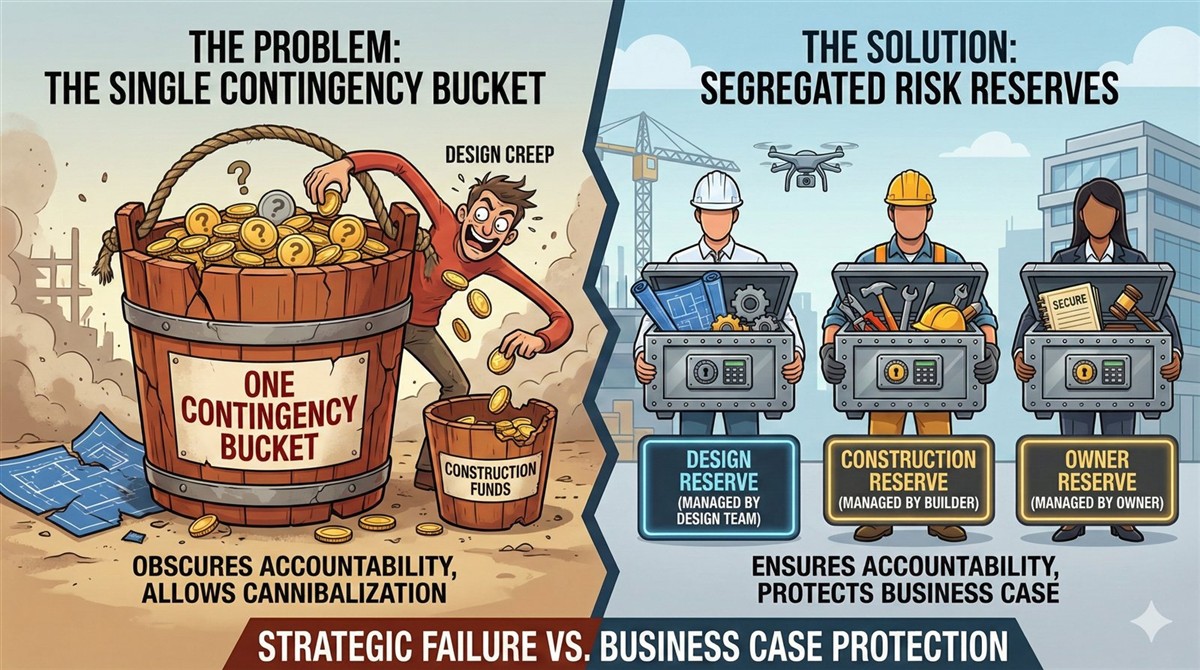
In capital development, a generic "10% contingency" is a work of fiction. When an Owner fails to categorize risk, the budget becomes an open invitation for "design creep" and field inefficiency. Lumping funds together allows an architect to spend the roof repair budget on a lobby chandelier before a shovel ever hits the dirt.
Professional management requires the compartmentalization of risk. By separating contingencies, the Owner creates a granular view of where cost growth is happening—whether it is an evolving design, poor trade buy-outs, or owner-directed scope changes. Forensic analysis consistently shows that projects using segregated contingencies are significantly more likely to maintain their original pro forma.
Design Contingency: Managing the Evolution of Intent
The Design Contingency is a pre-construction tool used to manage the "design-to-cost" process. It is not for new scope; it is for the refinement of the existing program as drawings move from concept to 100% Construction Documents (CDs).
The Burn-Down Rule: This allowance must start high during conceptual phases (typically 15% to 25%) and reduce to zero the moment the CDs are finished. If there is still a "Design Contingency" during the rough-in phase, the budget is being mismanaged.
Preventing Design Creep: This fund covers the details that inevitably emerge as a design professional fleshes out a program. By isolating these costs, the Owner can see if the design team is staying within the "intent" or if they are adding "nice-to-have" features that threaten the construction budget.
Accountability: If the design contingency is exhausted before the drawings are at 50%, it is a signal that the architect’s vision has outpaced the Owner's wallet.
Construction Contingency: The Performance Buffer
This fund is reserved for the friction of field execution. In a Guaranteed Maximum Price (GMP) or Construction Manager at-Risk (CMAR) environment, this contingency is often managed by the contractor to maintain the price ceiling.
The Buy-out Differential: Construction is subject to "known unknowns." This contingency covers trade buy-out gaps (when a sub’s actual bid is higher than the estimate), labor productivity issues, and non-negligent design errors discovered in the field.
Contractor Ownership: This fund is for the contractor’s use to manage the performance risks they have assumed. It protects the project from the "death by a thousand cuts" that occurs when minor field adjustments derail the schedule.
Incentivized Savings: Many GMP contracts include a "savings sharing" clause, where a portion of the unused construction contingency is returned to the contractor at completion. This aligns the contractor’s profit motive with the Owner’s interest in efficient field execution.
Industry Term: Buy-out - The process of the General Contractor executing subcontracts with trades after the GMP is set. The "Buy-out Profit/Loss" is the difference between the estimated cost and the actual contract price.
Owner’s Contingency: The Strategic Safety Net
This is the ultimate management reserve. It sits outside the construction contract and is controlled exclusively by the Owner or their Representative. It is the final defense for the business case.
"Unknown Unknowns": This fund is reserved for major scope changes requested by the Owner, "Acts of God" (Force Majeure), or unforeseen site conditions—such as buried hazardous waste—that could not have been reasonably detected during pre-construction.
Strategic Control: By keeping this fund separate, the Owner ensures they are the only ones who can authorize a major change to the project’s mission. It prevents the designer or contractor from dipping into the "emergency fund" to solve a performance issue.
Financial Integrity: The Owner’s contingency protects the project from lender-level defaults and ensures that funds are available for the final 5% of the project, where most "surprises" manifest.
Industry Term: GMP (Guaranteed Maximum Price) - A contract type where the contractor is compensated for actual costs plus a fee, up to a maximum ceiling. Costs exceeding the GMP are the contractor's responsibility.
“So What?”: The ROI of Granular Risk Management
Financial Impact: Segregated buckets prevent the early "bleeding" of funds. It ensures that money meant for the finish line isn't spent in the first turn.
Accountability: You cannot hold a contractor accountable for a design error if their contingency is lumped in with yours. Separation identifies exactly who is responsible for cost growth.
Schedule Risk: When risks are clearly identified and funded, decisions happen faster. A project with an "emergency fund" ready for unforeseen conditions doesn't stop for three weeks while the lawyers argue over who pays for a buried tank.
Transparency: Forensic auditing becomes straightforward. You can see at a glance if the design team is over-budget or if the contractor is struggling with trade buy-outs.
The Bottom Line
If you don't separate your contingency buckets, you won't know where the leak is until the well is dry. Construction is a game of probability. Categorizing your risks into Design, Construction, and Owner funds is the only way to ensure the math mirrors the mud.
Control the buckets, or the buckets will control your budget.
Actionable Strategy for Owners:
Audit the GMP: Before signing a GMP, ensure the Construction Contingency is clearly defined and separated from the Owner’s Reserve.
Enforce the Burn-Down: At every design milestone (SD, DD, CD), review the Design Contingency. It should be shrinking as the drawings get more detailed.
Define "Unforeseen": Ensure your contract explicitly states what constitutes a "Construction Contingency" item versus an "Owner’s Contingency" item.
Hold the Line: Never allow the design team to use the Owner's Contingency for "scope enhancement." If they want a more expensive finish, they have to find the money in the Design Contingency or cut something else.