The Conspiracy of Optimism
In the high-stakes environment of capital programs, there is a dangerous psychological trap: the need for social stability. On highly cohesive teams, members often stop thinking critically to maintain the peace. This lack of friction creates a false sense of security that endangers project health.
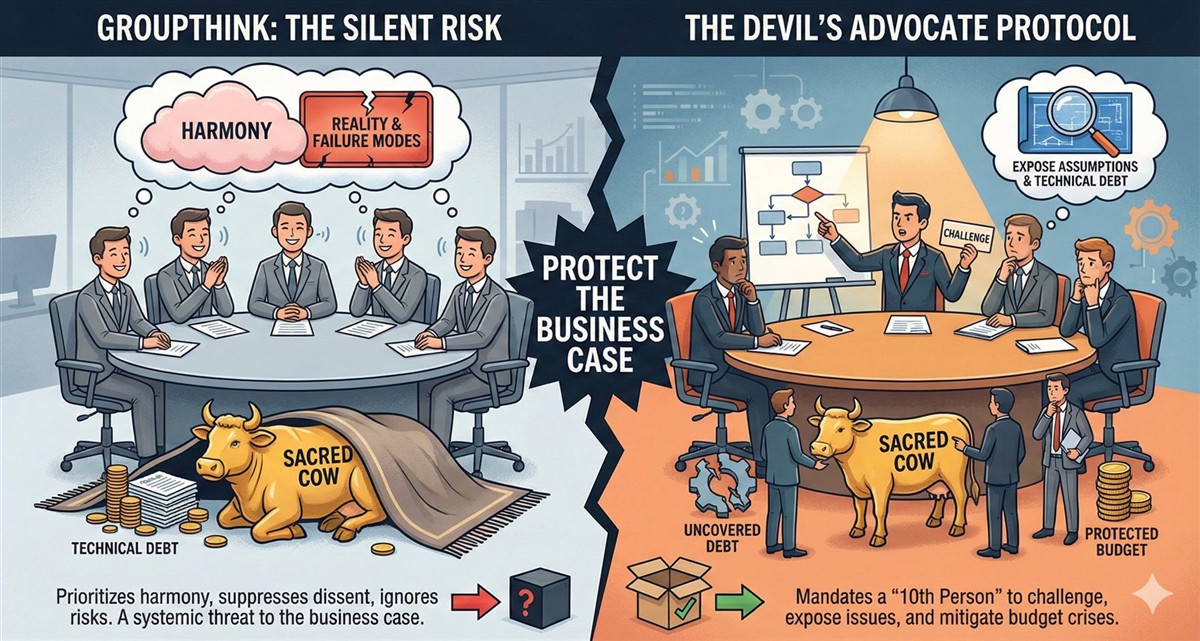
We call this the "Conspiracy of Optimism." It is characterized by an illusion of invulnerability where teams take extreme risks without proper analysis because "everyone is on board." When the GC, the Architect, and the Owner’s Rep are in total agreement, the Owner should be deeply skeptical. Self-censorship is common; individual members withhold concerns to avoid being labeled "troublemakers." This filtered information ensures that expert opinions contradicting the chosen path are ignored until the project hits a wall.
The Devil’s Advocate as a Governance Tool
Critical scrutiny is not a personal preference; it is a formal responsibility. Whether it is a designated Value Study Leader (VSL) or a senior project executive, someone must be tasked with breaking the cycle of automatic agreement.
Challenging Mindsets: The advocate must question every design solution and project outcome against real-world constraints. If a design looks "visionary," the advocate asks how it will be maintained in year ten.
Killing "Sacred Cows": Every project has them—design elements or methods that the team assumes are untouchable. The advocate forces the team to defend these assumptions with data rather than hunches or "standard practice."
The "Dumb" Question Strategy: By feigning ignorance or asking seemingly simple questions, the advocate draws out missing information that others are too embarrassed or too comfortable to mention. If the team cannot explain a complex MEP sequence to a layperson, they do not understand the risk.
The 10th Person Rule: Finding the Fatal Flaw
To mitigate Owner risk, sophisticated organizations implement the "10th Person" rule. If nine people in a room agree on a strategy, the tenth person is contractually or procedurally obligated to find the fatal flaw.
Countering Optimism Bias: This rule acts as a buffer against the tendency to hide bad news. It forces a deep dive into "what we don't know we don't know."
Lateral Thinking: The 10th Person ignores the "pseudo-comprehensive" schedules and budgets that mask ignorance. They look at the project from the outside in, referencing historical failures and "Malevolent Hiding Hand" scenarios to anchor the team in reality.
Validating the Critical Path: Before a baseline schedule is accepted, the 10th Person must attempt to "break" it. If the schedule survives a rigorous challenge to its logic and resource loading, it is fit for the Owner’s approval.
Owner Risk Mitigation: Avoiding the "Malevolent Hiding Hand"
For the Owner, groupthink is a direct threat to the budget and schedule. Unchallenged teams often hide barriers to creativity and "malevolent" project failures until they are too late or too expensive to fix.
Ensuring Predictability: Critical scrutiny in the pre-construction stage improves the team’s ability to anticipate outcomes early. It is far cheaper to argue over a drawing in a conference room than to litigate a failure in the field.
Defending the Business Case: The Devil’s Advocate ensures that project "pinch points"—the areas where cost and schedule are most vulnerable—are cleared only after rigorous testing against the original objectives.
Maintaining Technical Honesty: This role ensures that the Management Information System (MIS) reflects the actual state of the project, not the "sanitized" version the team wants the Owner to see.
“So What?”: Why Friction Saves Capital
Financial Impact: Identifying a design flaw through a Devil's Advocate review costs {{CONTENT}} in materials. Finding it during the rough-in costs six figures in rework and interest.
Schedule Risk: Groupthink leads to "Recovery Schedules" that are based on hope, not math. Rigorous dissent keeps the schedule anchored in reality.
Personnel Implications: High-performing teams are built on "Radical Candor." When dissent is encouraged, the best talent stays engaged because they know their technical expertise actually matters.
Strategic Consequences: An Owner who demands friction is an Owner who gets results. Predictability in construction is the byproduct of a team that has survived its own internal criticism.
The Bottom Line
Harmony is a virtue in a choir, but it is a liability in a construction trailer. If your project meetings are too quiet and the reports are too perfect, you are likely the victim of the "Conspiracy of Optimism."
The Devil’s Advocate is the only person in the room whose job is to protect you from the team's collective blind spots. Mandate the dissent. Invite the friction. It is the only way to ensure the math mirrors the mud.
Actionable Strategy for Owners:
Appoint the Dissenter: Explicitly assign a "10th Person" role for all major gate reviews (50% Design, GMP setting, Baseline Schedule approval).
Reward Dissent: If a team member flags a risk that turns out to be real, recognize it publicly. Make "finding the flaw" a badge of honor, not a career-killer.
Audit the Silence: If an OAC meeting ends early with zero disagreements, stay behind and ask: "What are we all pretending is fine that actually isn't?"
Use Outside Views: Bring in a third-party reviewer for a one-day "Red Team" session. A fresh set of eyes is often the best cure for Groupthink.
#TheOwnersProject #ConstructionTechnology #DigitalTransformation #ModernMethodsOfConstruction #ConstructionRobotics #Automation #Sustainability #NetZero #DigitalTwin #BuildingForABetterSociety #SupplyChain #ConstructionOps #AssetManagement #CPM