The "Paper Hero" Problem
In my twenty-five years of oversight, I’ve seen countless "Paper Heroes"—architects and engineers who design intricate, "visionary" details that look spectacular on a 4K monitor but are physically impossible to build with a standard wrench or a concrete pump.
When constructability is ignored during the early design phases, the Owner is effectively subsidizing the design team’s education. You pay for the "learning curve" through Change Orders, RFI balloons, and the "Malevolent Hiding Hand" of field conflicts. Constructability is the process of injecting technical honesty into the design before the "Optimistic Beginning" becomes a "Scramble to Salvage."
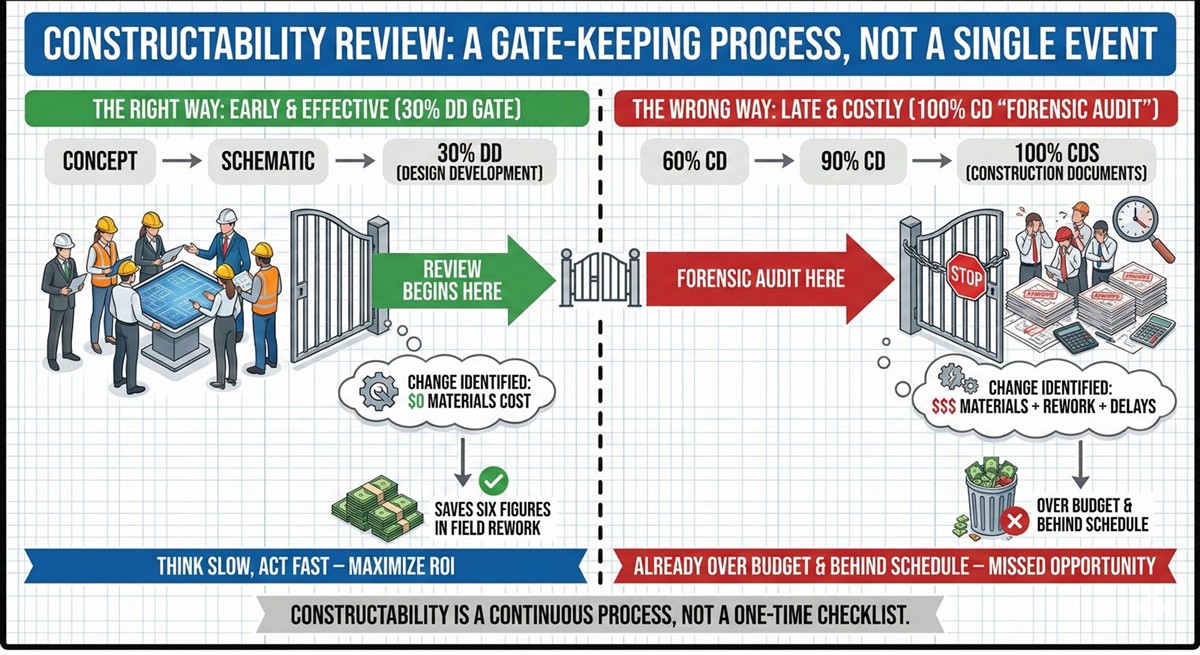
The Sweet Spot: 30% to 60% Design
The "law of physics" in construction is simple: the further the project progresses, the more expensive it is to change a line.
30% Design (Conceptual/SD): This is where you address the "Big Logic." Can the crane reach the back of the site? Are the MEP (Mechanical, Electrical, Plumbing) shafts sized for reality, or are they wishful thinking? At this stage, a constructability review is about site logistics and structural "bones."
60% Design (Design Development): This is the high-value window. This is where the CM (Construction Manager) and the trades must sit in a room and "build the building" digitally. We look for "trade handovers"—the places where the glazier’s work meets the mason’s work. If the flashing detail is wrong here, it’s a {{CONTENT}} fix. If it’s wrong in the field, it’s a heart attack.
90% Design (Construction Documents): At this stage, the review is about "fine-tuning." You are looking for missing dimensions, clear specifications, and bid-ability. If you find a major structural conflict here, you have already failed the 60% gate.
The Procurement and Mock-up Phase
Constructability doesn't stop with a red pen on a drawing. It continues through the "First-Run" studies.
Long-Lead Vetting: Constructability includes procurement. If a designer specifies a custom chiller from a factory in a country currently under a 50% tariff, that is a constructability failure. The "Means and Methods" include how you actually get the material to the site.
The Mock-up as a Physical Review: A full-scale mockup is the ultimate constructability review. It is the transition from "Paper Hero" to "Field Reality." If the trades can't build the mockup correctly in a controlled environment, they will never hit the quality standard on the 30th floor.
The "Scramble" Prevention: Why the Field is Too Late
Many Owners rely on the "RFI process" as their constructability strategy. This is a strategic error.
An RFI (Request for Information) is a confession that the design and the field are out of sync. Every RFI represents a delay in the rhythm of the build. Constructability reviews aim to kill the RFI before it’s born. By the time a Superintendent discovers a pipe-clash in the field, you have already accumulated "Technical Debt" that will be paid back with interest-heavy rework and trade stacking.
“So What?”: The Business Case for Early Review
Financial Impact: A robust 30/60/90 constructability sequence typically reduces Change Orders by 3% to 5% of the total GMP. On a $100M project, that is $3M to $5M of your contingency saved.
Schedule Risk: Early reviews eliminate the "surprises" that break the critical path. When the logic is vetted early, the "Optimistic Beginning" actually stands a chance of becoming a "Substantial Completion."
Personnel Implications: High-performing "A-Team" subcontractors prefer projects with vetted designs. If a job is a "clash-fest," your best subs will walk, leaving you with the "B-Team" to handle the most complex phases.
Strategic Consequences: An asset designed with constructability in mind has a lower Total Cost of Ownership (TCO). If the "maintenance guy" can actually reach the pump because the CM insisted on a wider clearance during the 60% review, the Owner wins for the next 20 years.
The Bottom Line
If you aren't doing constructability reviews at 30% and 60%, you aren't managing a project; you are just waiting for the first lawsuit to arrive. Constructability is the practice of finding the "Malevolent Hiding Hand" while it’s still in the trailer.
Demand the review. Pay the CM to do it right. And remember: the most expensive words in construction aren't "change order"—they are "we'll figure it out in the field."
Actionable Strategy for Owners:
Mandate the Schedule: Build 30/60/90 Constructability Gates into the pre-construction schedule. Do not allow the design team to "skip" a gate to save time.
Involve the Trades: Get the major mechanical and electrical subs in the room during the 60% review. They know the mud better than the person in the design studio.
Verify the Fixes: A review is useless if the redlines aren't incorporated. Audit the next set of drawings. If the same error appears twice, you have a process failure.
Walk the Model: Use BIM (Building Information Modeling) for clash detection at the 60% mark. If the model isn't "clash-free" before the GMP is signed, the GMP is a fiction.