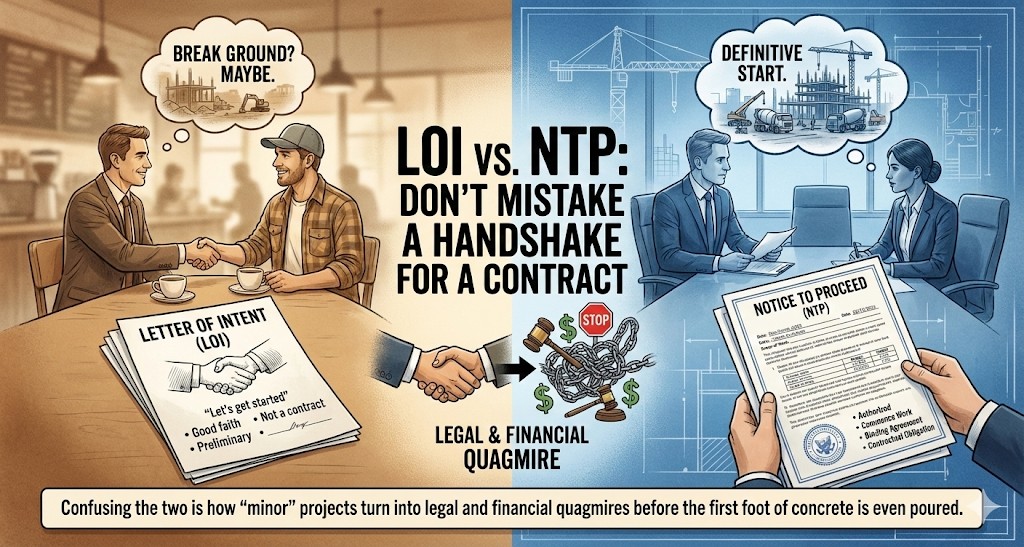
The Notice to Proceed (NTP): The Contractual Starting Gun
The NTP is the only "clean" way to start a project. It is the formal signal that the paperwork is over and the performance has begun.
Triggering the Clock: The NTP establishes the "Day Zero" for the project. It starts the countdown for substantial completion and triggers the liquidated damages (LD) clock. Without an NTP, your project schedule is merely a suggestion.
Post-Execution Document: You do not issue an NTP until the ink is dry on the prime contract. It is the bridge between the legal department and the field office.
Operational Transition: The NTP authorizes the contractor to occupy the site, pull permits, and begin billing against the schedule of values.
Owner’s Prerogative: This is your lever. While an architect or consultant may draft it, the authority to issue the NTP sits solely with the Owner. Never delegate the "starting gun" to a third party.
The Letter of Intent (LOI): The High-Risk Interim Tool
An LOI is a "break glass in case of emergency" document. It’s used when you need to order long-lead equipment (like switchgear or chillers) or start site clearing while the lawyers are still arguing over indemnity clauses.
Temporary Authorization: It is a stop-gap, not a substitute. It allows limited, specific work to proceed to protect the critical path.
Financial Caps: A professional LOI is never open-ended. It must include a Not to Exceed (NTE) dollar amount. If you don't cap the spend, you’ve effectively handed the contractor a blank check.
Termination for Convenience: The LOI must give the Owner a "trap door." If financing falls through or the contract negotiations turn toxic, you need the right to pay for work-in-place and walk away.
Commitment Gaps: Beware—an LOI often lacks the robust warranties, insurance requirements, and dispute resolution frameworks found in the full contract. You are operating in a "legal gray zone."
Owner Risk: The Tactical Divide
| Feature | Letter of Intent (LOI) | Notice to Proceed (NTP) |
|---|---|---|
| Legal Status | Provisional / "Agreement to Agree" | Fully Bound / Executed Contract |
| Schedule Control | Loose; often lacks LD protections | Fixed; starts the contractual clock |
| Owner Exposure | High (Potential for quantum meruit claims) | Capped (Defined by Contract Sum/GMP) |
| Scope | Restricted to specific tasks | Full Project Scope |
The "Quantum Meruit" Trap
If a project is aborted while under an LOI, you don't necessarily pay the "bid" price. You may be liable for quantum meruit—a "reasonable commercial rate." In a volatile market, "reasonable" usually means "more than you budgeted." Without a signed contract, you lose the protection of your negotiated unit prices.
The Authority to Bind
The most dangerous words in construction are "Go ahead, we'll fix the paperwork later." Personnel changes, board shifts, or a contractor's "change of heart" can erase verbal commitments instantly. If it isn't in writing—with a clear dollar limit—it didn't happen.
The Bottom Line
An NTP is a marriage; an LOI is a first date with a pre-nuptial agreement. Use an LOI only when the cost of delay exceeds the risk of a "provisional" contract. Use an NTP for everything else. If you find yourself operating under an LOI for more than 30 days, your project is drifting into a high-risk "at-large" status.
Negotiate the contract, issue the NTP, and get to work.