The Baseline Lie: Why Schedules Fail Before Day One
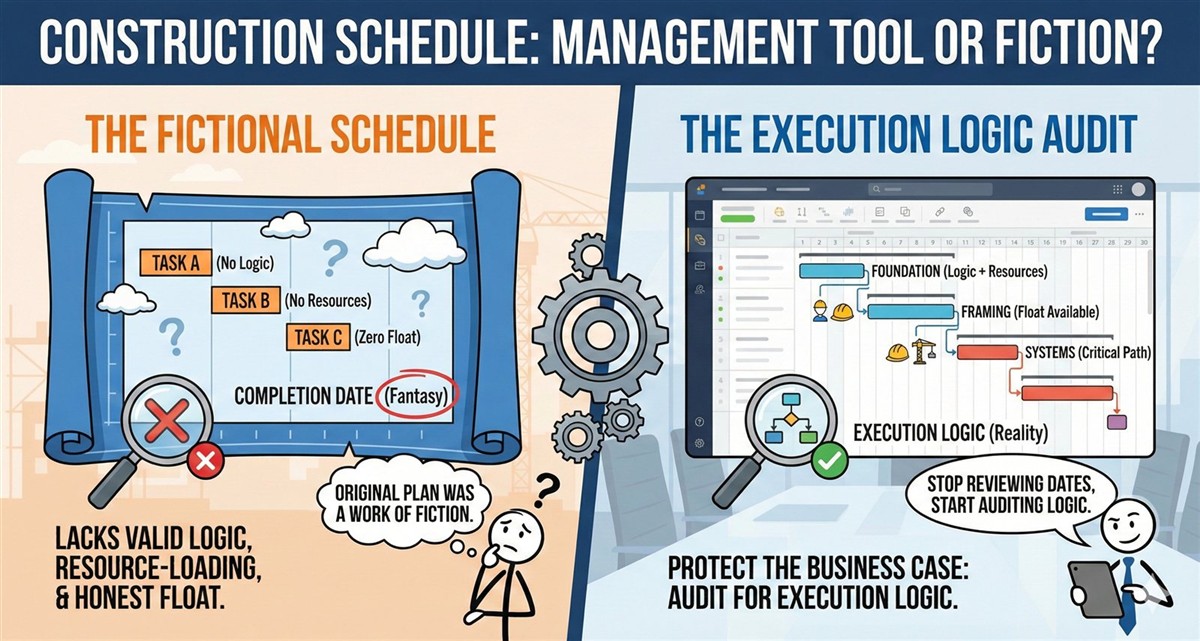
The costliest mistake in capital project management is accepting a schedule built for reassurance instead of reality. It usually arrives in the pre-construction phase: a 1,500-line Primavera P6 export, color-coded and dense. It looks authoritative. It meets the "Schedule of Values" requirements. Most importantly, it shows a Substantial Completion date that perfectly aligns with the project’s Pro Forma.
Six months into the project, the "slip" begins. Two weeks here, a month there. The Project Manager blames "unforeseen conditions" or "supply chain volatility." But in many cases, the schedule didn't slip. It simply lacked the structural integrity to survive contact with reality. It was a marketing document masquerading as a project control.
For an Owner, a schedule is the primary mechanism for risk mitigation and cash flow forecasting. When that mechanism is broken, the project isn't just late—it’s unmanaged.
The Pre-Construction Investment: "Think Slow, Act Fast"
Successful programs front-load the intellectual labor. Industry best practices dictate that the most critical scheduling work happens before a single bucket hits the dirt. Many Owners treat the baseline schedule as a checkbox—a document required to release the first payment. They hire a CM, the CM hires a scheduler, and the scheduler produces a document based on idealized durations.
This creates a "Default Culture" that drifts toward chaos because it lacks field-level buy-in. The alternative is Integrated Production Control. This requires the "Primary Triad"—Owner, Designer, and Contractor—to align on the Master Schedule during pre-construction.
If the contractor cannot explain the logic behind a sequence, or if the procurement of "Long Lead" equipment lacks discrete tracking milestones, the schedule is a wish, not a plan. Ownership must demand that the schedule reflects the Procurement Log, not just the site work. A schedule that doesn't track submittals and lead times is merely a countdown to a delay.
Logic Over Luck: The CPM Audit
A schedule without logic is just a list of dates. In a Critical Path Method (CPM) schedule, every activity must be linked to a predecessor and a successor. The "Skeptical Owner" looks for two red flags that signal a fictional plan:
Artificial Constraints: When a scheduler "pins" an activity to a specific date (e.g., "Must Start On") to force the end date to work, they break the CPM logic. If the preceding task is late, the pinned task stays put, hiding the delay. This is how "sudden" six-month delays happen at 90% completion.
Open Ends: Every task except the first and last must have a connection. Open ends create "ghost float," allowing the contractor to ignore delays that should be triggering alarms.
Ownership must audit the Baseline Schedule for Logic Density. If 20% or more of the tasks are "constrained" by manual date entries rather than sequence logic, the schedule is a house of cards. It will not react to field changes, rendering it useless for forecasting.
Industry Term: Total Float
The amount of time that an activity can be delayed from its early start date without delaying the project finish date. It is the "breathing room" in the plan.
The War Over Float: It Is Not a Gift
In construction, Float is the breathing room between tasks. There is a perennial war over who "owns" it. Contractors often view float as a private buffer for their own inefficiencies. Owners must view it as a shared project resource to mitigate project-wide risks.
Best practices from the CMAA Standards of Practice suggest that float is an asset of the project, not a proprietary tool of the contractor. When a schedule shows "zero float" from day one, it is a signal of front-end loading. The contractor has artificially inflated durations to hide their buffer. Conversely, a schedule with excessive float usually indicates a lack of detail. Both scenarios leave the Owner blind to the project’s true health.
The Recovery Schedule Trap: Confession, Not Solution
When a slip becomes undeniable, the "Recovery Schedule" appears. Owners often view this as a solution; in reality, it is a confession of failure. A recovery schedule that simply compresses future durations without changing the "Means and Methods" is a fantasy.
If a contractor was averaging 10,000 square feet of drywall per week and the recovery schedule requires 20,000 square feet to "catch up," Ownership must demand evidence of the following:
Manpower Loading: Is there a documented increase in the labor force to support the doubling of production?
Site Logistics: Has the logistics plan been updated for the increased density of trades?
Trade Stacking: Is the cash flow projection updated to reflect the "stacking of trades," and has the impact on productivity been modeled?
Without these answers, the recovery schedule is merely a tool to justify the next pay application. It treats the symptoms while the project’s business case bleeds out.
Industry Term: Time Impact Analysis (TIA)
A formal method used to demonstrate how a specific change or delay event impacts the project’s critical path. It compares the schedule "as-planned" against the schedule "as-impacted" by the change.
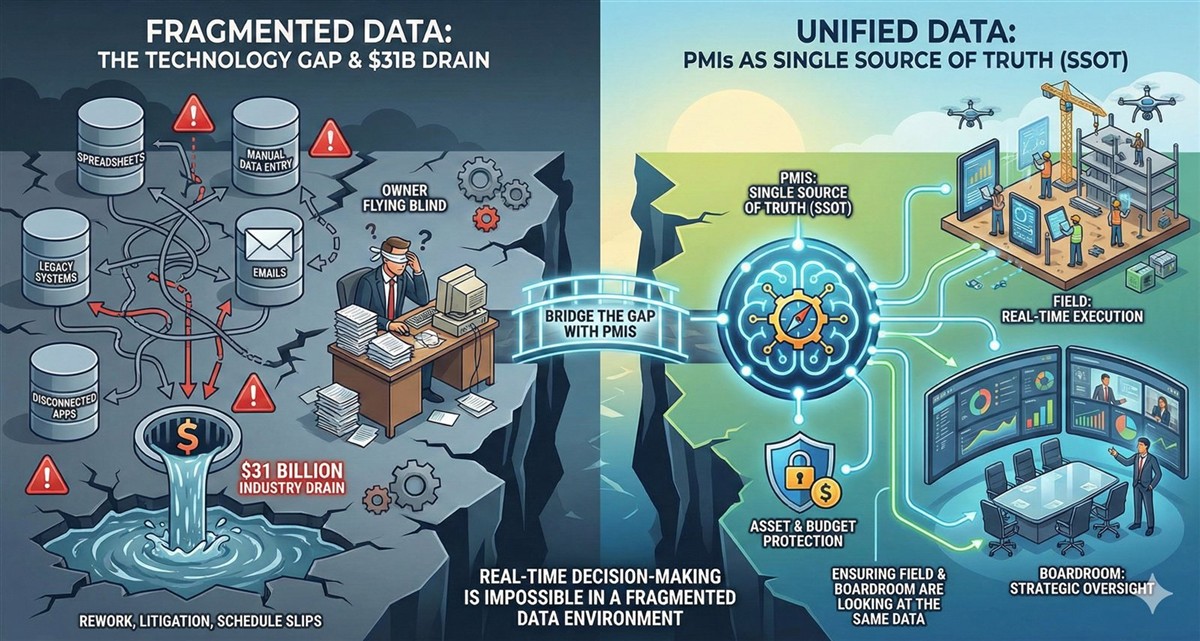
The "Single Source of Truth": Field Validation
There is often a disconnect between the "Management Schedule" in the trailer and the "Field Schedule" on the clipboard. Operational excellence requires Takt Planning or Last Planner Systems—short-term, granular look-ahead schedules (usually 3–6 weeks) that the foremen actually use.
If the 6-week look-ahead doesn't match the Master Schedule, the Master Schedule is dead. Ownership should ignore the 50-page PDF report. Instead, walk the site and ask a foreman what the goals are for the next 14 days. If the answer isn't reflected in the schedule, the "Single Source of Truth" has been bifurcated. The project is now being run on intuition, not data.
“So What?”: Why Fictional Schedules Kill Assets
Financial Impact: Inaccurate schedules lead to "Impact Costs"—the hidden expenses of trade-stacking, overtime, and lost productivity that are rarely captured in simple change orders but devastate the IRR.
Schedule Risk: A project that is "on time" on paper but "behind" in the field leads to rushed inspections, compromised quality, and a higher Total Cost of Ownership (TCO).
Personnel Implications: High-stress, "emergency" finishes burn out project teams and lead to the litigation horror stories that plague the industry.
Strategic Consequences: For an Owner, a delay is not just a date move; it is a missed revenue window, increased carrying costs, and potentially a breach of lender covenants.
The Owner’s Action Plan
Mandate CPM Logic: Require all schedules to be logic-driven with minimal constraints. Rejection of the baseline is better than the acceptance of a lie.
Audit the Baseline: Hire a third-party scheduler to perform a "Logic Health Check" before the first shovel hits the ground.
Enforce Narrative Reporting: Do not accept a Gantt chart without a written narrative explaining the "Critical Path," changes in logic, and resource availability.
Own the Float: Explicitly define float ownership in the General Conditions of the contract as a project-wide resource.
Validate via Look-Aheads: Review 3-week to 6-week look-ahead schedules during every OAC meeting. If they don't roll up into the Master, the Master is invalid.
The Bottom Line
A schedule that ignores the laws of physics and the realities of the labor market is a liability, not an asset. If the math doesn't mirror the mud, the project isn't slipping—it was never on solid ground to begin with. Control the logic, or the logic will control your budget.