Here is a curated list of the top 10 predictions for the construction industry in 2026, including real-world companies and hashtags to follow.
1. The "Agentic AI" Boom
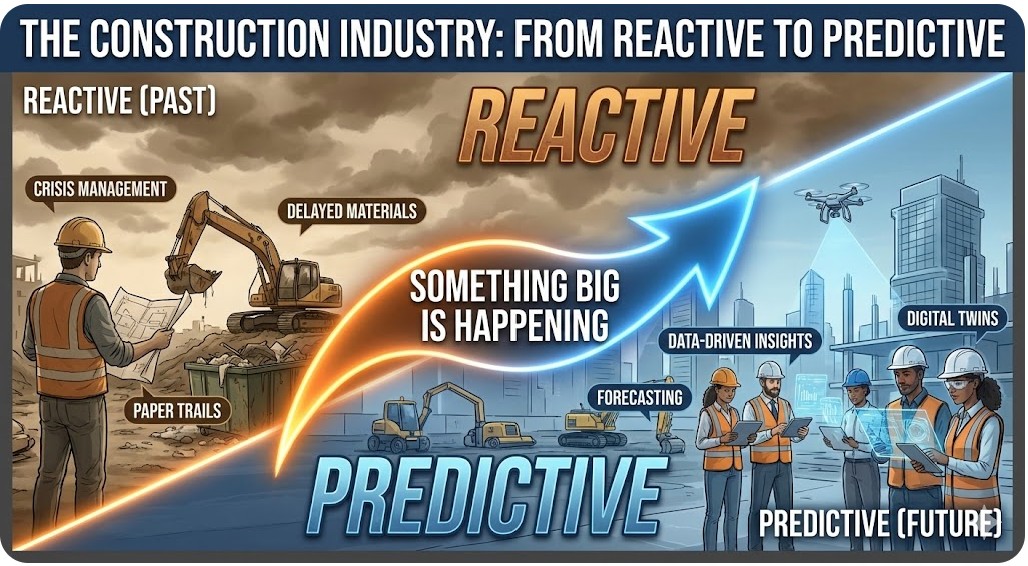
In 2026, AI moves beyond simple chatbots to Agentic AI—autonomous systems that orchestrate schedules, resolve design conflicts, and manage procurement by predicting shortages before they occur.
Real Example: Trimble Construction has moved beyond monitoring into agentic systems that observe, plan, and make autonomous decisions across project phases.
2. Offsite Construction Crosses the Tipping Point
With the industry needing approximately 500,000 new workers this year, modular and panelized construction have become the standard for multifamily and healthcare projects, cutting "dry-in" times by 50–60%.
Real Example: Laing O'Rourke is a global leader in DfMA (Design for Manufacture and Assembly), treating building sites like outdoor assembly plants.
Turner Construction Company Launched xPL Offsite in May 2025 to scale its existing offsite manufacturing efforts. It combines over 20 years of commissioning, prefabrication, and modular construction experience with DfMA principles to deliver faster, safer, and more reliable projects.
3. Data Center Dominance
Data center construction is exploding to support AI processing. 2026 projects focus on "advanced energy facilities"—specialized substations and liquid-cooling infrastructure
Real Example: Microsoft is executing multi-billion dollar AI-focused expansions (like the Racine County, WI site) that set the standard for high-density, liquid-cooled facilities.
4. 3D Printing Scales to Production
Once a novelty, large-format 3D printing is hitting commercial scale. In 2026, we are seeing the first neighborhoods of printed homes completed in record time to combat the housing shortage.
Real Example: Hive3D Builders is actively printing energy-efficient residential communities, reducing material waste by up to 60%.
5. Robots as "Force Multipliers"
Robotics are now essential assistants. From robotic bricklayers to autonomous excavators, these machines are bridging the labor gap by working alongside human crews.
Real Example: Monumental has deployed autonomous "swarm" robots that perform precision bricklaying on active sites, integrated directly with digital twins.
6. Carbon Accounting Becomes Mandatory
Sustainability is now a requirement for bidding. In 2026, Environmental Product Declarations (EPDs) are standard, with firms scrambling for low-carbon cement and recycled materials.
Real Example: Heidelberg Materials is leading with near-zero-carbon cement production through massive carbon capture projects (CCUS).
7. Digital Twins for the Entire Lifecycle
Digital Twins now expand beyond design into operations. In 2026, these models integrate with IoT sensors to monitor building performance long after construction is finished.
Real Example: cmBuilder.io provides 4D site simulation and digital twin tools that allow contractors to simulate "what-if" scenarios before a single concrete pour.
8. Supply Chain "No-Regret" Strategies
Contractors are abandoning "just-in-time" delivery for "no-regret" strategies like strategic stockpiling and vertical integration to bypass global shipping and tariff volatility.
Real Example: Skanska has pioneered the use of data-driven command centers to hedge against supply chain and material cost volatility.
9. The "Subscription-Based" Jobsite
High tech costs have led to a surge in Construction-as-a-Service (CaaS). Firms now subscribe to drones and AI software rather than buying them outright, keeping capital costs low.
Real Example: ToolWatch by AlignOps offers subscription-based asset management and GPS tracking, making advanced logistics accessible to mid-sized contractors.
10. Smart City Infrastructure
Construction is moving beyond buildings to integrated systems. 2026 marks a peak in infrastructure spending for Smart City components like EV charging grids and automated flood sensors.
Real Example: NEOM (The Line) remains the most ambitious real-world laboratory for cognitive cities, utilizing massive modular construction and AI-driven logistics.
The Bottom Line
The construction industry in 2026 is agile. With a "split market" creating high demand in tech and infrastructure but softness in traditional sectors, the winners will be those who use technology to squeeze every drop of productivity out of a limited workforce.
#Trimble #ConstructionTechnology #DigitalTransformation #LaingORourke #ModernMethodsOfConstruction #DfMA #Turnerconstruction #xploffsite #MicrosoftCloud #Azure #DataCenterConstruction #HiveASMBLD #3DPrintedHomes #AffordableHousing #Monumental #ConstructionRobotics #Automation #HeidelbergMaterials #Sustainability #NetZero #cmBuilder #4DPlanning #DigitalTwin #Skanska #BuildingForABetterSociety #SupplyChain #ToolWatch #ConstructionOps #AssetManagement #discoverneom #TheLine #SmartCities