The $31 Billion Information Leak
In construction, we are exceptionally good at generating data. Between sensors, BIM models, daily field reports, and RFI logs, a modern $500M project produces more information than a mid-sized corporation. The tragedy is that most of this data is dead on arrival.
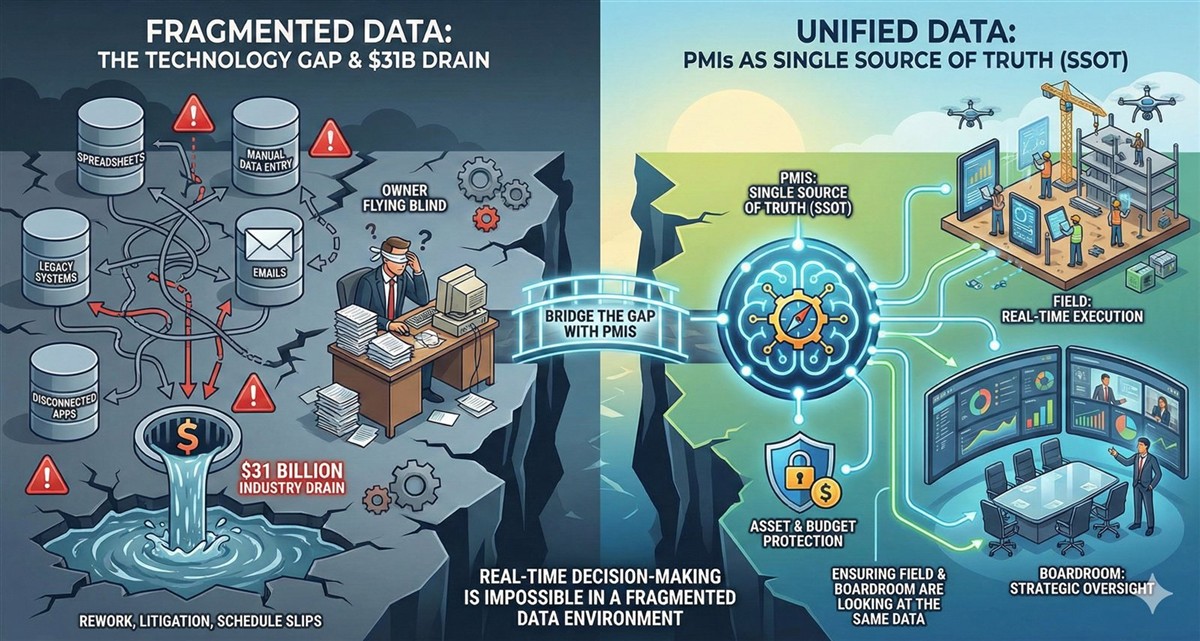
It sits in a "Data Graveyard"—isolated PDF folders, local hard drives, and the personal inboxes of project managers. For the Owner, this technology gap creates a dangerous illusion of control. You receive a monthly report that looks professional, but that report is often two weeks old, manually compiled from five different sources, and riddled with "copy-paste" errors.
In a high-stakes environment where interest rates are elevated and labor is scarce, managing a project with 1990s-era information systems is a dereliction of fiduciary duty.
Scary Fact: Approximately 17% of businesses worldwide continue to rely on fax machines for critical operations as of 2024, and the construction sector likely exceeds that baseline.
The Cost of the "Swivel-Chair" Integration
The most common failure mode in construction technology is the lack of system interoperability. We call this "swivel-chair integration": the process of a human being looking at one screen (e.g., a timesheet) and manually typing that data into another screen (e.g., the cost-tracking spreadsheet).
The Error Rate: Human data entry has a predictable error rate. When you multiply that across 10,000 line items in a GMP (Guaranteed Maximum Price) budget, the "noise" in your financial reporting becomes deafening.
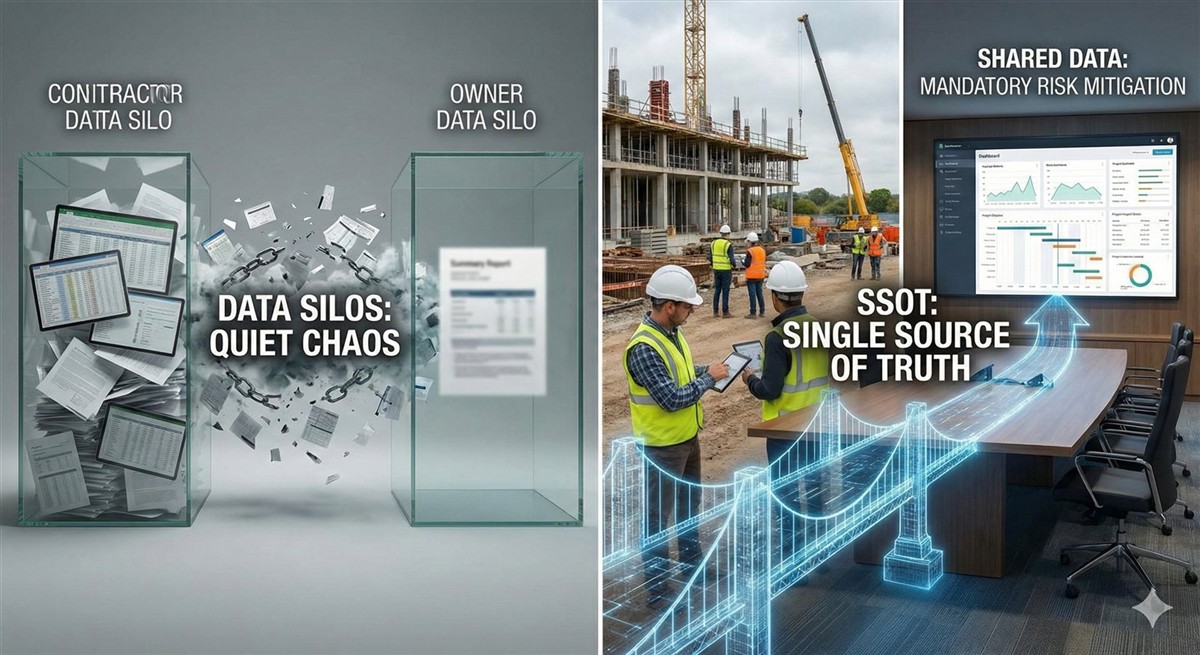
Data Silos: The GC has their system. The Architect has theirs. The Owner’s Rep has a third. Because these systems don't talk, the "truth" is fragmented. If the workforce planning tool doesn't see the actuals from the field, you end up forecasting 30 electricians for a phase that only requires 15—or worse, vice versa.
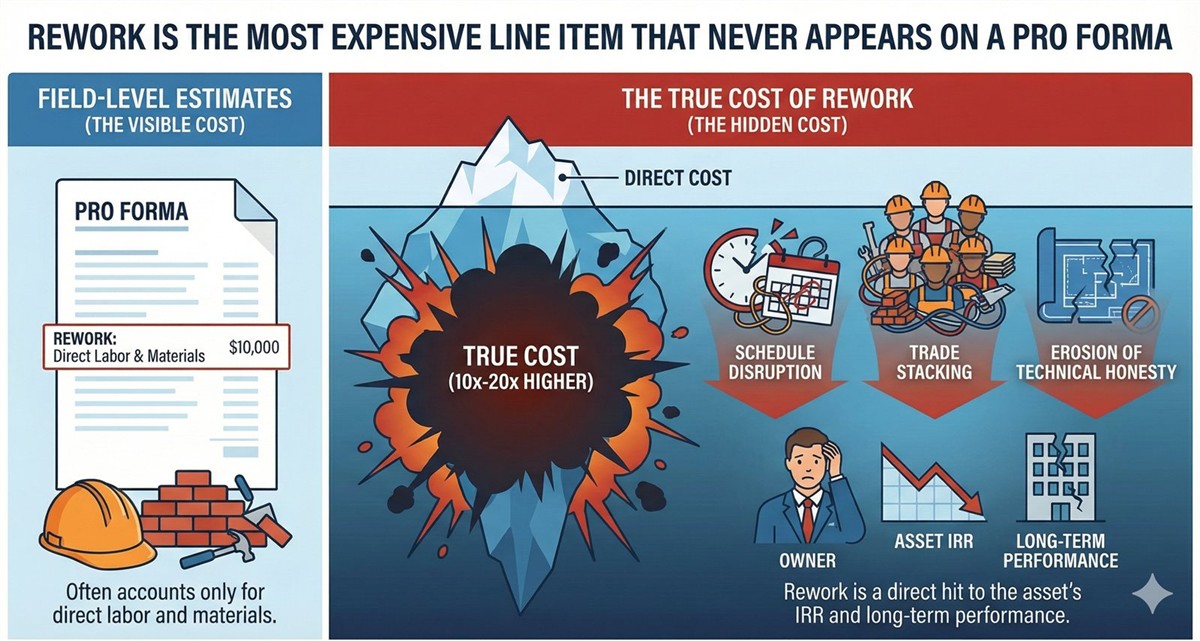
Manual Re-entry as a Risk: Every time data is moved manually, the project loses its "Technical Honesty." Information is filtered, sanitized, or simply mistyped. By the time it reaches the Owner’s desk, it’s no longer a management tool; it’s a work of fiction.
The Version Control Crisis: Building Off Yesterday’s News
There is an expensive joke in the field: "Who has the current plans?" "The guy who just left for lunch."
Poor document control is responsible for nearly 50% of industry rework. When a field crew installs wiring or plumbing based on Revision 3 while the Architect just issued Revision 5 via email, the Owner pays the bill.
The "Email Graveyard": If your "Common Data Environment" is an Outlook inbox, you don't have a process; you have a liability. Critical revisions get buried. Approval stamps are missed.
The Delta of Uncertainty: In a project with 5,000 drawings, version control is not a clerical task—it is a risk-mitigation workstream. Without an automated system that pushes the current set to mobile devices in the field instantly, you are practically guaranteeing that someone, somewhere, is building it wrong.
As-Built Integrity: At the end of the project, the Owner expects an accurate "As-Built" set for the facilities team. If version control was sloppy during construction, your "As-Builts" are a guess. This increases the Total Cost of Ownership (TCO) because the maintenance team will spend the next 20 years playing "find the pipe" behind drywall.
The Visibility Void: Why You’re Always the Last to Know
Construction is a game of momentum. A delay in the foundation pour today impacts the MEP (Mechanical, Electrical, Plumbing) rough-in six months from now. Without real-time visibility, the Owner is perpetually reacting to the past.
Lagging Indicators: Most monthly reports are "lagging indicators." They tell you what went wrong last month. Real-time visibility requires "leading indicators"—RFI response times, submittal aging, and daily manpower counts. If these aren't visible in a live dashboard, you cannot make a " go/no-go " decision until it’s too late to save the schedule.
Delayed Decisions: In construction, time is quite literally money (interest, carrying costs, lost revenue). If it takes three weeks to get a clear answer on a budget impact because the data is trapped in three different systems, the project loses its rhythm.
Conflicting Truths: At an OAC (Owner-Architect-Contractor) meeting, if the GC’s schedule says 80% complete and the Owner’s budget says 60% paid, and no one can explain the delta, you have a Single Source of Truth problem. You are debating the data rather than debating the project.
The Solution: The Single Source of Truth (SSOT)
To bridge the gap, the Owner must mandate a Common Data Environment (CDE) and a Project Management Information System (PMIS) that serves as the "Single Source of Truth."
Centralized Repository: Every RFI, submittal, drawing, and invoice must live in one place. No local copies. No side-emails. If it’s not in the PMIS, it didn't happen.
Automated Workflows: Replace "I’ll email you that submittal" with an automated approval workflow. This creates an audit trail that shows exactly who is holding up a decision. In 2026, "I didn't see the email" is no longer an acceptable excuse for a schedule delay.
BIM Integration: The 3D model (BIM) should be linked to the data. When a project manager clicks on a chiller in the model, they should see its procurement status, its warranty, and its current installation progress. This is the foundation of a "Digital Twin" that provides value long after the ribbon-cutting.
“So What?”: The Business Impact of Data Integrity
Financial Impact: Eliminating manual re-entry and version errors typically reduces project costs by 3–5%. On a $500M project, that’s $15M–$25M—more than enough to pay for the most expensive software on the market ten times over.
Schedule Risk: Real-time visibility allows for "micro-corrections." It prevents the sudden "six-month slip" by flagging the two-week delay in month two.
Personnel Implications: Your high-priced PMs and Supers should be managing trades and quality, not acting as data entry clerks. The technology gap burns out talent by forcing them to do low-value administrative work.
Strategic Consequences: An asset with a "clean" digital record (Digital Twin) is worth more on the open market. It is easier to finance, easier to insure, and significantly cheaper to operate.
The Bottom Line
Information is the most valuable material on your jobsite. If you wouldn't accept a foundation poured with contaminated concrete, don't accept a project managed with contaminated data.
The gap between the "field" and the "suits" is filled with the expensive debris of manual errors and siloed information. Close the gap by mandating a Single Source of Truth. In the modern era, the Owner with the best data is the Owner with the least risk.
Actionable Strategy for Owners:
Mandate the PMIS: Do not leave the software selection to the GC. Mandate a system that the Owner owns and controls.
Ban Manual Re-entry: Require all systems (Accounting, Scheduling, Field Reporting) to talk to each other via API.
Audit the Versioning: Once a month, pick a random crew in the field and check the revision date on their drawings against the PMIS. If they don't match, you have a process failure.
Demand Real-Time Dashboards: If you have to wait for the OAC meeting to know your budget status, your system is broken. You should be able to see your project health from your phone at any time.