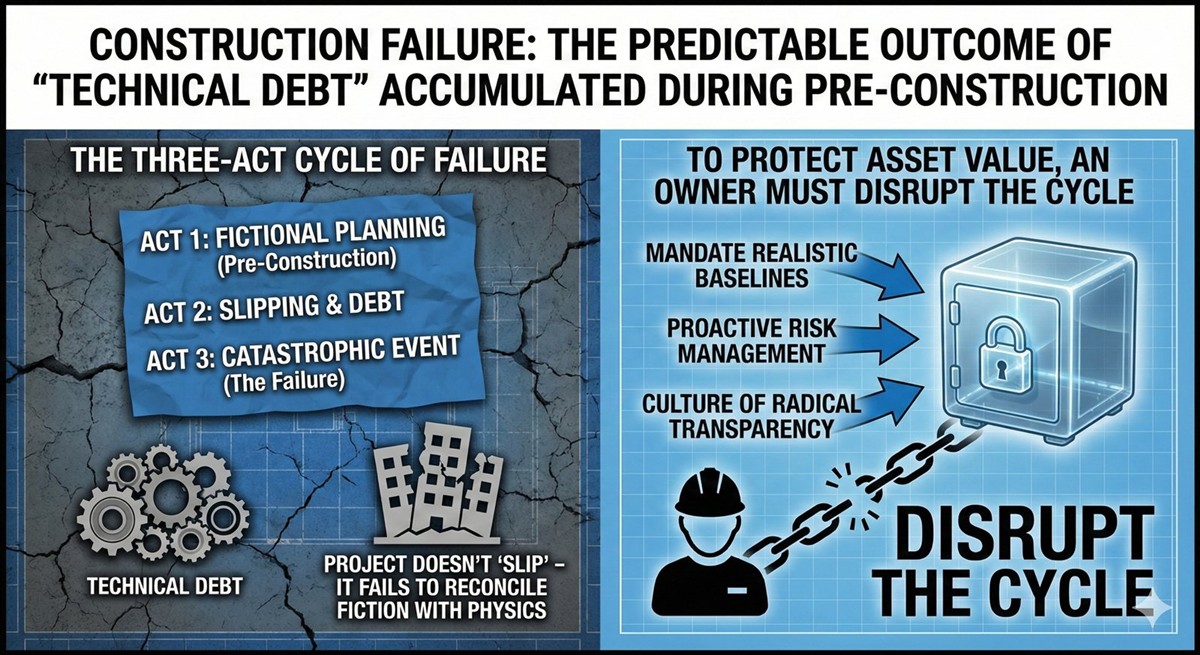
Act I: The Optimistic Beginning (The Seed of Failure)
Construction failures don't happen in the field; they are born in the boardroom months before the first shovel hits the dirt. This is Act I: The Optimistic Beginning. In this phase, the "Conspiracy of Optimism" takes hold.
Owners want to see a schedule that hits a revenue window. Contractors want to win the work. Architects want to protect the vision. The result? A baseline schedule built on best-case scenarios and a budget that ignores historical data in favor of wishful thinking. In today's fast pace data center builds, projects are launched with 30% electrical designs while the Owner is already cutting POs for long-lead gear. This isn't "fast-tracking"; it's a gambling exercise where the Owner is the only one who can't walk away from the table.
Act II: The Creeping Realization (Contact with Reality)
Act II occurs when the fictional plan meets the reality of the mud. Productivity falls short. Design conflicts—specifically in MEP coordination—emerge during the rough-in. Site conditions don't match the three borings the team did to "save money."
The hallmark of this phase is rationalization. Teams treat every setback as an isolated "unforeseen condition" rather than a symptom of systemic failure. The schedule slips by two weeks, then a month. Contingency funds are drained to fix errors that should have been caught in a BIM clash detection report. At this point, the project is already failed; the team just hasn't admitted it yet.
Act III: The Scramble to Salvage (The Cost of Desperation)
By Act III, the failure is undeniable. The team enters a reactive "scramble." Resources are thrown at the schedule, leading to "trade stacking" and a massive drop in productivity. Decisions are made based on urgency rather than strategy.
Quality suffers as the focus shifts from "building right" to "finishing now." This is where the Total Cost of Ownership (TCO) skyrockets. Rushed commissioning and bypassed punch lists result in an asset that might be "open," but is functionally broken. The damage to the budget and the Owner's reputation is often irreversible.
The Common Denominators: Why the Pattern Repeats
Across decades of oversight, the same four failure modes appear with depressing regularity:
1. The False Economy of Planning
Poor front-end planning is the top denominator in every post-mortem. This includes inadequate site investigation and premature procurement. In complex infrastructure, if the design isn't locked before the equipment arrives, you are paying the contractor to "design-build" on the fly at a premium.
2. Communication Vacuums
When the design team doesn't understand construction means and methods, or when the Owner doesn't communicate shifting business priorities, the project drifts. Information vacuums are always filled with assumptions, and in construction, assumptions are always expensive.
3. Static Risk Management
Most project teams treat the Risk Register as a compliance exercise—a spreadsheet filled out at kickoff and filed away. Real risk management is dynamic. If the register isn't updated weekly to reflect the actual conditions on the ground, it isn't a management tool; it’s a work of fiction.
4. The Under-Resourcing Trap
Owners often try to save on "soft costs" by understaffing the project management or field supervision teams. This is a strategic error. A Superintendent stretched across three work areas cannot maintain quality or safety. Cutting corners on the people who protect your capital is the ultimate false economy.
The Data Center Litmus Test
Data centers are the ultimate laboratory for project failure. The extreme precision and compressed timelines amplify every weakness. Successful data center builds share a specific DNA:
Constructability Reviews: Conducted before concrete is poured, not after.
BIM Maturity: Conflicts are caught digitally, where they cost {{CONTENT}} to fix.
Integrated Commissioning: The "start-up" begins during design, not at Substantial Completion.
Supply Chain Dominance: Long-lead items (transformers, chillers) are treated as the primary schedule drivers, with constant oversight of the factory floor.
“So What?”: Why Failure Patterns Matter to the Board
Financial Impact: Failure leads to "Impact Costs"—the unquantified drain of trade stacking, rework, and accelerated shipping that erodes IRR.
Schedule Risk: A project that finishes late misses its revenue window. For many Owners, a three-month delay on a data center or hospital is more expensive than the entire construction fee.
Personnel Implications: High-stress "Act III" environments burn out your best talent. When a project becomes toxic, the "A-Team" leaves, and you are left with the "B-Team" to finish a complex build.
Strategic Consequences: A building delivered under duress has a higher Total Cost of Ownership. If the commissioning was rushed to hit a date, the operational costs will bleed the asset for years.
The Bottom Line
The pattern of project failure is predictable, which means it is preventable. It requires the courage to demand a realistic baseline and the discipline to maintain technical honesty when things go wrong.
A project doesn't fail because a pump was late; it fails because the team pretended they didn't need the pump until it was already on the critical path. As an Owner, your job isn't to hope for the best; it's to disrupt the pattern of optimism before it becomes a pattern of disaster. Control the logic, or the logic will control your budget.
Actionable Strategy for Owners:
Audit the Baseline: Hire a third-party scheduler to perform a "Logic Health Check" on the master schedule. If the math doesn't mirror the mud, reject it.
Mandate Dissent: Appoint a "Devil’s Advocate" in every major gate review. If no one is finding flaws in the plan, they aren't looking hard enough.
Staff for Complexity: Ensure your field supervision ratio matches the technical difficulty of the build. One Super per $20M of work is a baseline; data centers require more.
Fast News is Better Than Good News: Reward the team for flagging a two-week slip in Month 2 so you don't have to manage a six-month slip in Month 12.