The "Carfax" Trap: NYC Dirt Has a Memory
Out-of-state developers frequently enter the New York market—specifically Long Island City, Gowanus, or North Brooklyn—assuming a "standard" environmental play will suffice. They engage a national firm to produce a generic Phase 1 ESA, satisfy the lender, and move to excavation.
This is where the business case collapses.
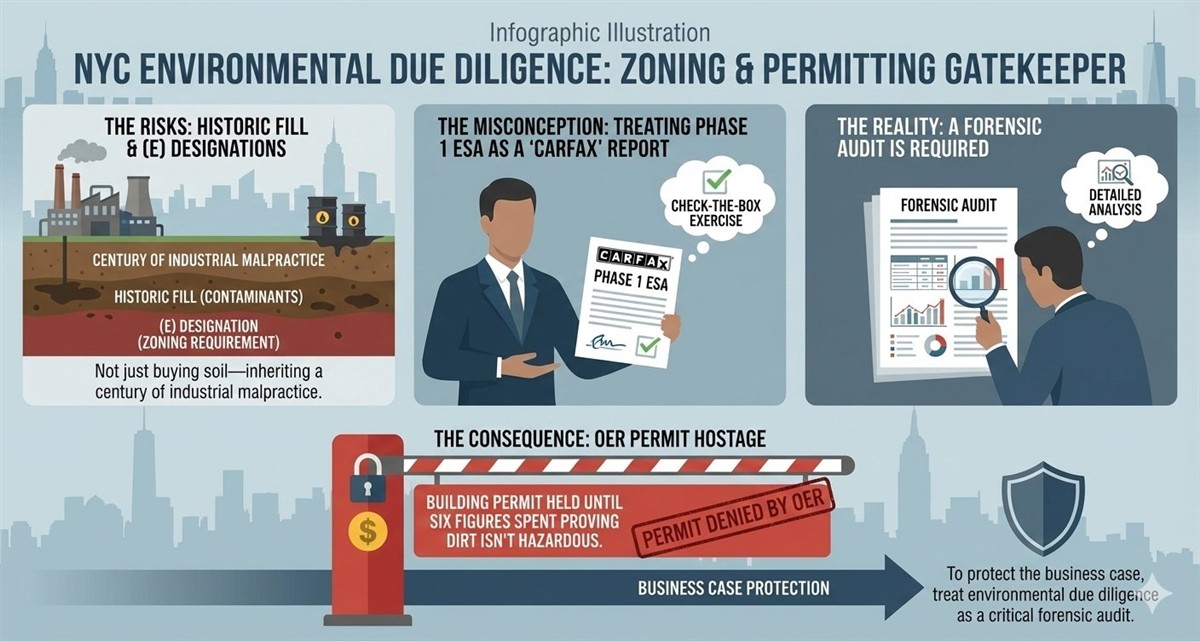
In the five boroughs, the ground is a repository of historical neglect. "Historic Fill"—the ash, coal, and industrial refuse used to level the city a century ago—is the baseline condition. NYC due diligence must be a historical autopsy. A generic report that misses a dry cleaner operating in a basement in 1924 is a liability. The New York City Office of Environmental Remediation (OER) will find the "ghosts" of that industry, even if the consultant didn't.
The (E) Designation: The Permitting Lock
In most jurisdictions, an Environmental Site Assessment (ESA) satisfies a bank. In NYC, it satisfies the Department of Buildings (DOB).
If a site carries an (E) Designation on the zoning map—typically triggered by a neighborhood-wide rezoning—the Owner is effectively locked out of the permit process. The (E) is a formal tag indicating the city suspects Hazardous Materials, Air Quality issues, or Noise pollution.
The Permitting Hook: The DOB will not issue a New Building (NB) permit until the OER issues a Notice to Proceed (NTP).
Hazardous Materials: An NTP is only granted after the OER approves a Remedial Investigation Report (RIR) and a Remedial Action Work Plan (RAWP).
Air and Noise: The (E) may mandate specific HVAC fuel sources (natural gas only) or high-decibel window attenuation (STC ratings). These are not suggestions; they are requirements for a Certificate of Occupancy.
Ignoring the (E) Designation during the war room phase leads to months of carrying costs while the project waits for a bureaucrat to review soil samples.
Historical Forensics: Proximity is Risk
NYC density means the "adjacent property" risk is the Owner's risk. A standard Phase 1 looks at old maps; an NYC Phase 1 must be a forensic investigation.
Sanborn Maps and Ghost Industries: A "Battery Service Station" from 1936 translates to lead and acid in the groundwater. "Unspecified manufacturing" in 1950 is code for chemicals dumped into a floor drain.
Vapor Intrusion: This is the silent project-killer. Volatile organic compounds (VOCs) from a metal plater or printer a block away can migrate through soil gas into the project site. Failure to catch this in the Phase 1/Phase 2 transition results in the mandatory installation of a Sub-Slab Depressurization System (SSDS) and a 20-mil vapor barrier—often at a 300% markup during the "Scramble to Salvage" phase of construction.
Testing the "NYC Soup": Soil Disposal Math
In New York, the question is not if the soil is contaminated, but how much it will cost to get rid of it.
Historic Fill Baseline: Expect 3 to 10 feet of fill loaded with SVOCs and heavy metals (Lead and Arsenic). Characterizing this during a Phase 2 ESA is a requirement for early soil disposal pricing.
The Delta of Cost: Moving "clean" fill costs approximately $25 per ton. Moving "impacted" fill to a regulated facility in Pennsylvania or Ohio can exceed $150 per ton. On a 10,000-square-foot site with a full cellar, this delta represents a $500,000 unbudgeted hit to the contingency, assuming the site generates approx. 4,000 tons of soil.
Dewatering: If the project requires a cellar, testing the groundwater is mandatory. If the water is "hot," the project will require an on-site treatment plant before the DEP allows discharge into the sewer.
“So What?”: Why Due Diligence is a Fiduciary Duty
Financial Impact: Proper soil characterization early allows for accurate GMP (Guaranteed Maximum Price) negotiations. Guessing at soil disposal is a recipe for seven-figure Change Orders.
The VCP/BCP Payoff: If the site is sufficiently "brown," enrollment in the NYC Voluntary Cleanup Program (VCP) or the State Brownfield Cleanup Program (BCP) can yield massive tax credits—sometimes covering 10–20% of total development costs. An Owner’s Rep earns their keep by navigating this enrollment during the 60-day due diligence window.
Schedule Mitigation: The OER process is slow. Starting environmental reviews only after the GC is on board ensures the Owner will pay for "General Conditions" (trailers, security, fences) while the site sits idle awaiting OER approval.
Liability Protection: A Notice of Satisfaction (NOS) from the OER is the only way to exit a deal and sell the asset without a permanent environmental asterisk on the price.
Definitions for the Field
NTP (Notice to Proceed): The OER’s "green light" required to obtain a DOB permit.
NOS (Notice of Satisfaction): The "finish line" document required for a final Certificate of Occupancy.
Historic Fill: Urban "junk" soil; the reason every NYC site is a mini-brownfield.
The Bottom Line
In New York City, the dirt is a line item that can sink an IRR. Owners should be skeptical of a "clean" Phase 1 on a former industrial block. A clean report is often a lie that will be exposed the moment the DOB checks the zoning map.
Hire consultants who speak the language of the OER. Invest in a real Phase 2 during due diligence. The most expensive words in NYC construction are not "change order"—they are "(E) Designation." Think slow in the war room, or pay the fallout in the field.
Actionable Strategy for Owners:
Check the Zoning Map: Identify (E) Designations before signing the LOI.
Budget for the Phase 2: Assume you will need borings. If the consultant says you don't, find a new consultant.
Vet the Disposal: Demand the GC provide a "Soil Disposal Characterization" based on the Phase 2 data before the GMP is finalized.
Account for OER Lead Times: Build four months of "Environmental Review" into the pre-construction schedule. Don't let the "Conspiracy of Optimism" tell you it will take 30 days.