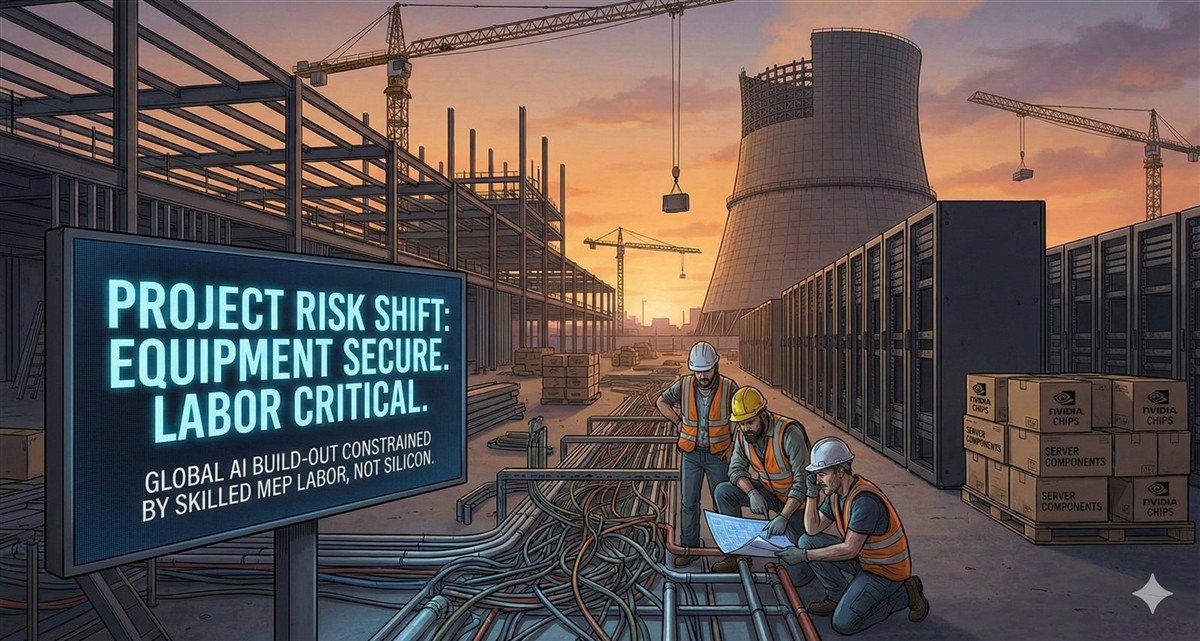
AI software moves at light speed. Physical infrastructure moves at the speed of a journeyman electrician. The industry currently faces a fundamental disconnect: the capital is ready, the chips are shipping, but the skilled labor required to install them is a finite—and shrinking—resource.
The following overview examines the widening gap between AI ambitions and jobsite reality.
The Complexity Surge
Data centers are no longer just warehouses for servers; they are becoming high-density power plants. The shift toward liquid cooling and high-voltage distribution has transformed "basic" MEP (Mechanical, Electrical, Plumbing) work into precision engineering. A standard data center build now requires a level of technical expertise that the current labor market was never scaled to provide.
The Talent Cliff
The "Silver Tsunami" is no longer a projection; it is a current event. As the most experienced foremen and supers retire, they take decades of institutional knowledge with them. The vocational pipeline is not replenishing fast enough to meet the demand of the $1 trillion AI infrastructure build-out.
Resource Cannibalization
Hyperscalers—Google, Microsoft, Amazon—are vacuuming up the specialized labor market. This creates a Tier 1 labor shortage for everyone else. When the largest players in the world are bidding for the same localized pool of pipefitters and electricians, the cost of labor ceases to be a line item and becomes a project-ending risk.
So What?
Financial Impact: Labor premiums will cannibalize project contingencies. Fixed-price contracts will become rarer as subcontractors refuse to shoulder the volatility of labor availability.
Schedule Risk: Commissioning dates are now tied directly to labor headcount, not equipment delivery. Expect "manpower-driven" delays to become the primary cause of schedule slippage.
Asset Performance: Rushed work by under-trained crews leads to poor workmanship, increasing the Total Cost of Ownership (TCO) through premature equipment failure and maintenance headaches.
The Bottom Line
The smartest algorithm in the world still requires a human to wire the rack and pipe the liquid cooling arrays. In the race for AI dominance, the winner won't be the one with the most data, but the one who secures the most copper and the hands to install it.
Read the full breakdown on the labor bottleneck at Wired: https://www.wired.com/story/why-there-arent-enough-electricians-and-plumbers-to-build-ai-data-centers/