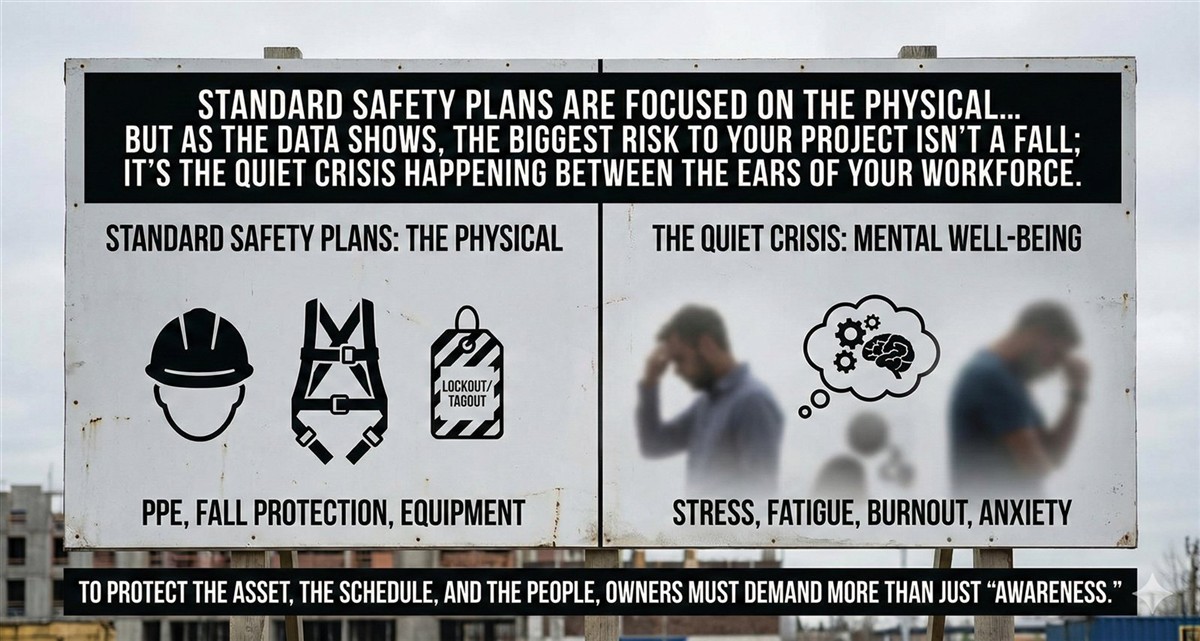
A clean safety record is usually measured by hard hats, harnesses, and OSHA logs. But the most dangerous threat to your project isn't a faulty crane or a trench collapse—it's what is happening under the hard hat.
In 2022, approximately 6,000 construction workers died by suicide. That is six times more than the number of workers killed in jobsite accidents. If a site had a structural failure that killed one person, we’d shut down the state. Yet, we are losing an entire division of labor every year to a crisis we rarely discuss at the OAC (Owner-Architect-Contractor) meeting.
The Math of a Mental Health Crisis
For an Owner, this isn't just a moral issue; it is a massive, unquantified risk to the capital program.
The Velocity Gap: Suicides in construction occur at a rate of 56 per 100,000—75% higher than the general male workforce.
The Overdose Correlation: In 2023, the industry saw nearly 16,000 fatal drug overdoses, often stemming from self-medicating chronic physical pain or untreated anxiety.
Presenteeism: Workers who are physically present but mentally absent. This leads to the "invisible" costs: rework, missed QC details, and safety "near-misses" that eventually become "hits."
Why Our Industry is a Pressure Cooker
The construction environment is a perfect storm for mental health decay. We demand 60-hour weeks, push aggressive schedules to hit loan milestones, and foster a "tough-it-out" culture that treats vulnerability as a defect.
When you add economic instability—the "boom-bust" cycle of seasonal work—and isolation from families during travel-heavy projects, the foundation starts to crack. We are operating an aging, male-dominated workforce that is statistically less likely to seek help and more likely to have access to lethal means.
The Business Impact: Beyond the Soft Costs
Ignore the human element, and the project health suffers. Mental health issues manifest in the budget and schedule as:
Labor Shortage Aggravation: With 700,000 skilled workers needed, losing people to preventable mental health crises is a drain on the talent pool.
Insurance and Liability: Substance abuse on-site (opioids, alcohol) is a ticking time bomb for workers' comp claims and catastrophic general liability events.
Schedule Integrity: Absenteeism and high turnover (up to 40% in some field positions) are direct symptoms of burnout and stress.
So What?
If you are an Owner, Developer, or Senior Executive, you need to realize that psychological safety is a deliverable. A stressed, distracted, or addicted workforce cannot build a high-quality asset on time.
When a worker misses a QC check because they are battling depression, it’s a latent defect waiting to happen. When a foreman is "checked out," the schedule float disappears. You pay for this crisis in the form of rework, delays, and insurance premiums, whether it’s on the ledger or not.
The Bottom Line
We spent the last 30 years perfecting physical safety. It’s time we apply that same rigor to the neck up. A "zero-accident" goal that ignores 6,000 suicides a year is a failure of leadership.
Stop treating mental health as a HR "perk" and start treating it as risk mitigation.