The Friday Afternoon RFI: Why Executive Composure is a Project Asset
It is 4:45 PM on a Friday. An RFI (Request for Information) hits the inbox: “URGENT: Structural Conflict – Grid Line J-12.” In capital project management, those words are a detonator. By 5:00 PM, the engineer is blaming the architect, the General Contractor (GC) is claiming a “latent condition,” and the lender is questioning the monthly draw. Survival depends on processing this noise without flinching.
The Gantt Chart Fallacy
New owners expect a $500M Gantt chart to be a prophecy. It is actually a wishlist. Projects are not linear; they are a series of controlled explosions. The Owner’s Representative doesn't stop the explosions—that’s an expensive impossibility. The job is ensuring the debris lands where the budget and schedule can absorb it. If a jobsite is too quiet, someone is likely hiding a Change Order (CO) in their truck.
The Strategic Value of Float
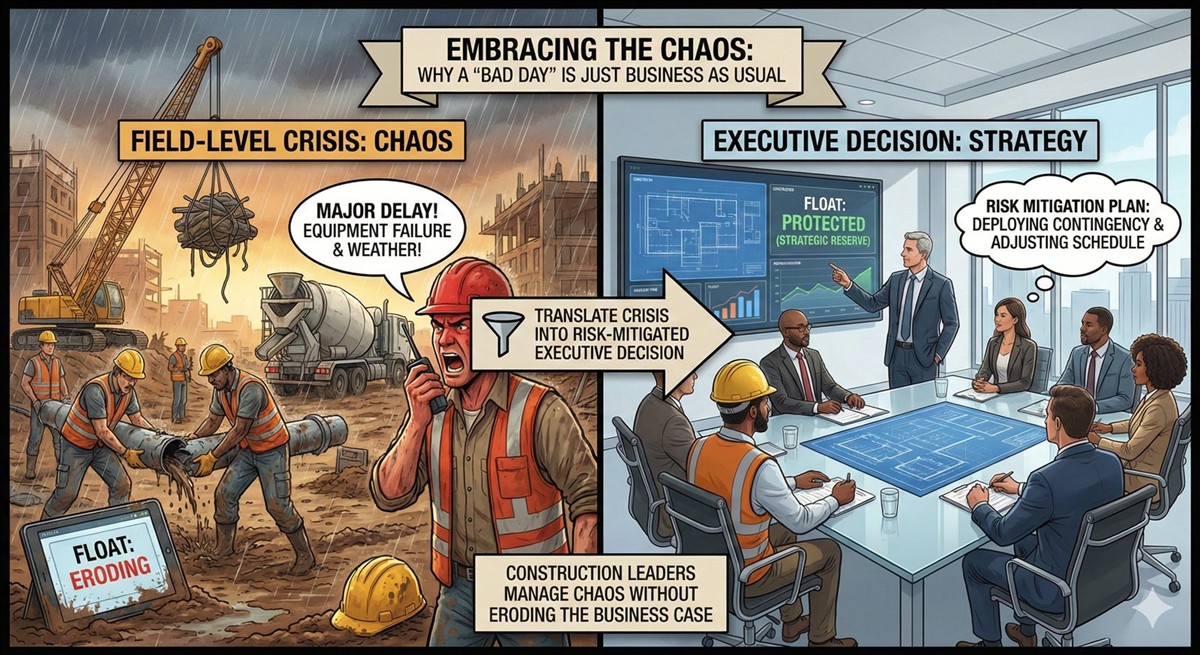
Executive-level indigestion usually stems from the "Unknown Unknown." You can model rain; you cannot model a 19th-century burial ground found during excavation. This is where Float—the amount of time an activity can be delayed without moving the final completion date—becomes your most valuable currency.
To a board, Float looks like inefficiency. To a seasoned leader, it is the only thing standing between a successful ROI and a default notice. When a project loses its Float, it loses its options. Protecting it isn't about laziness; it’s about maintaining the luxury of a calculated response when the inevitable crisis arrives.
Bilingualism: Field Notes to Pro Formas
Owner’s Representatives must be bilingual. You must speak the blunt language of the jobsite where steel is late because a Bill of Lading went missing. Then, you must translate that into the risk-mitigated vernacular of the boardroom.
When the GMP (Guaranteed Maximum Price)—the contractual cap on the owner’s financial exposure—is under pressure, the messaging must remain disciplined. You don't tell investors "we’re in trouble." You tell them you are "optimizing the contingency to account for market volatility while maintaining pro forma targets." Same problem, different zip code.
“So What?”
Indecision is the most expensive line item on any budget.
Financial Impact: A one-week delay on a major development can exceed $100k in carry costs alone.
Schedule Risk: Burning Float on minor issues leaves the project defenseless against late-stage shocks.
Asset Health: Panic-driven decisions rarely prioritize project values. Short-term fixes create long-term maintenance nightmares.
The Bottom Line
Construction is messy, loud, and professionally insulting. If you wanted a predictable life, you should have gone into accounting. But there is nothing like standing on a TCO-cleared floor that everyone swore three months ago would never be finished.
Stay skeptical, stay sharp, and keep the boots in the car.