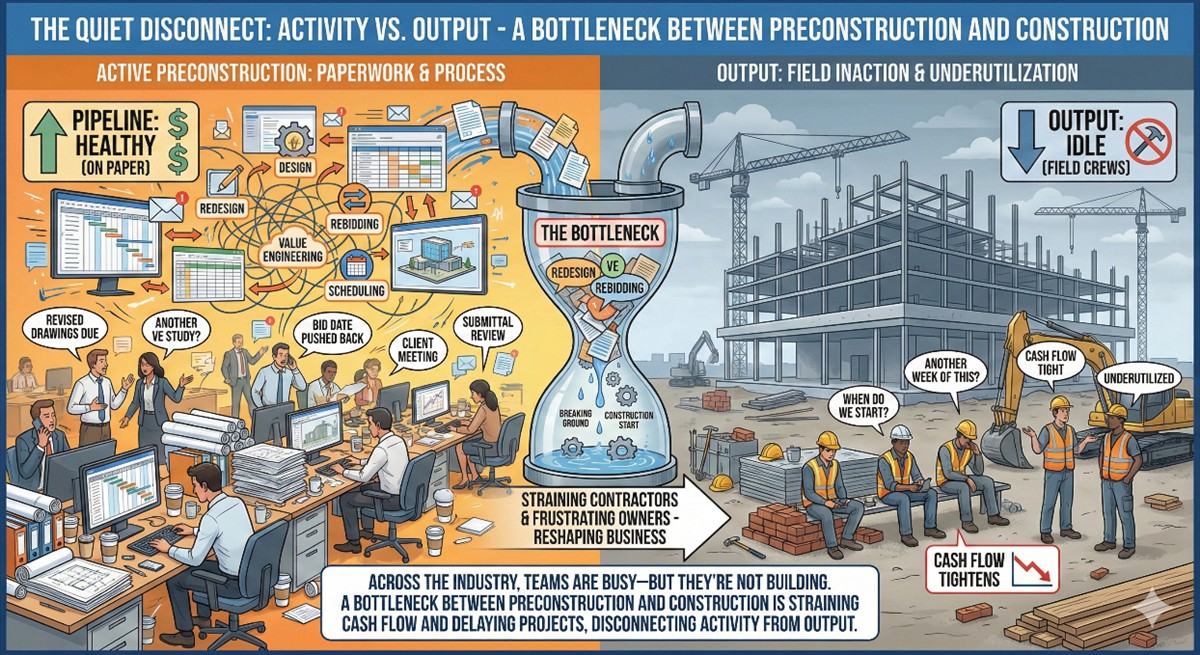
The phones are ringing. Estimating is slammed. Preconstruction teams are stretched across multiple pursuits. By every internal metric, the work is there.
So why aren't cranes going up?
Across the industry, a quiet disconnect has emerged between activity and output. Teams are busy—but they're not building. Projects are cycling through design, redesign, value engineering, and rebidding without ever breaking ground. The pipeline looks healthy on paper while field crews sit underutilized and cash flow tightens.
This isn't a slowdown in the traditional sense. It's something more insidious: a bottleneck between preconstruction and construction that's straining contractors, frustrating owners, and reshaping how firms need to think about their business.
What's Driving the Disconnect
Several forces are converging to keep projects stuck in preconstruction limbo.
Financing hesitancy. Lenders are sitting on approvals longer, requiring more equity, or pulling back entirely on certain asset classes. Private projects put on hold jumped 36.7% year over year in early 2025, while public projects showed relative stability. The contrasting trends suggest uncertainty among private developers is contributing to a hesitation to break ground.
Cost uncertainty and margin compression. Construction cost escalation has leveled off from the post-pandemic spikes, but aligning budgets with contractor price expectations remains a challenge—and a major risk to the industry. Material prices remain approximately 44% higher than 2020 levels, and tariff-related increases on steel, aluminum, and copper products are showing up directly in bid prices. Many contractors report at least one project in the past year that was canceled or scaled back because updated material quotes pushed the budget beyond what the market would accept.
The rebid cycle. Every tariff announcement or rate change triggers another round of value engineering sessions. Projects at 60-90% design keep cycling through scope adjustments rather than moving to mobilization. Owners are asking for multiple rebids, phased pricing, or GMP guarantees that contractors can't comfortably provide without larger contingencies—which then blow the proforma.
Labor constraints waiting in the wings. Aggressive immigration enforcement has created immediate disruptions in major markets that will have lasting negative effects on industry capacity. Currently, workforce-related disruptions are partially masked by limited activity—but they will become acutely noticeable when demand accelerates. Nearly 78% of firms report difficulty filling craft trade positions, which constrains how many projects can actually be tackled even when demand materializes.
A Tale of Two Markets
The "busy, but not building" phenomenon isn't hitting everyone equally. The construction market is unusually unbalanced at present—a few strong sectors alongside broad weakness in core markets.
Contractors tied to data centers and advanced manufacturing are seeing average backlogs of 10.9 months. Others are closer to 8 months. Smaller contractors are reporting just 5.8 months. It's a split market, and the divergence is accelerating.
Mega projects—those with $1 billion or greater total construction cost—reached approximately $134 billion of total work through September 2025, which is 47% greater than the same period the prior year. The impact of mega projects on construction spending cannot be underestimated. They explain how overall spending remains elevated despite declining project counts elsewhere.
For contractors not positioned in data centers, semiconductor manufacturing, or federally funded infrastructure, the picture is different. Work in builders' pipelines fell for contractors with less than $100 million in annual revenue, while firms with over $100 million in sales booked more work. Larger firms are expanding their project pipelines while smaller contractors face headwinds.
The Real Cost of Preconstruction Purgatory
When projects stall between design and groundbreaking, the damage compounds in ways that don't always show up immediately.
For contractors: Utilization looks healthy on paper—estimators are slammed, project managers are juggling multiple pursuits—but field crews aren't proportionally busy. That's a cash flow and retention problem waiting to happen. Firms have been sacrificing profit margins to keep prices stable, but that is only a temporary fix.
For owners and developers: Carrying costs accumulate while projects sit in preconstruction purgatory. The longer a project stays in this phase, the more vulnerable it becomes to market shifts that invalidate the original underwriting. Interest rate cuts, while helpful, do not change the underlying material price escalation or labor challenges caused by trade and immigration policies.
For the industry: The mismatch between preconstruction activity and actual construction starts creates a false sense of pipeline health. When conditions eventually shift and projects do move forward, the labor and material constraints that were masked by limited activity will surface all at once.
What the Data Is Telling Us
The early months of 2025 saw an unwelcome surge in project abandonment activity. Private projects placed on hold more than doubled over the past 12 months—up 110% compared to the prior year. Although private sector abandonments fell slightly, the overall level still remains well above historical averages.
Construction spending declined 4.7% in 2025 in real value and is expected to inch forward by only 0.4% in 2026—a modest improvement that signals continued headwinds. This near-flat trajectory highlights the importance of regional strategies, as conditions vary significantly between markets.
The consensus from industry economists: the likely outcomes do not favor continued waiting for policy-based cost relief. Trade and labor cost impacts will compound faster and greater than anticipated interest rate relief.
Strategic Implications
If you're an owner or developer with projects stuck in preconstruction, waiting for conditions to normalize isn't a strategy. The structural constraints—labor availability, material costs, financing terms—aren't cyclical problems that will resolve on their own.
For owners:
Revisit project delivery models. Design-build and integrated project delivery allow for earlier contractor engagement and more realistic cost alignment before deep investment in design.
Accept that cost volatility is the new baseline. Build contingencies accordingly and stop chasing the "right" moment to lock pricing.
Evaluate whether your preconstruction timeline is genuinely progressing or simply cycling. If the same issues keep resurfacing across rebids, the problem may be the program, not the market.
For contractors:
Be ruthless in cost control and make sure you're bidding correctly. Margin compression can only be absorbed for so long.
Recognize that preconstruction revenue isn't the same as project revenue. A busy estimating department doesn't pay field crews.
Position for the sectors and geographies where work is actually converting to construction starts—not just where RFPs are being issued.
For everyone:
Managing cost impacts will require operational adaptation regardless of the financing environment. Strategic timing and procurement decisions are more critical than waiting on macroeconomic policy changes.
The direction of macro-level cost drivers is clear. Trajectories differ between markets. Success in 2026 will be about big-picture approaches that recognize the nuanced interactions happening at a local level.
The Bottom Line
"Busy, but not building" isn't just a catchy phrase—it's a structural reality that's reshaping risk across the industry. The firms that recognize this disconnect and adapt their strategies accordingly will be positioned to capture opportunity when projects do move. The firms that mistake preconstruction activity for pipeline health will find themselves overextended when the music stops.
The work is there. The question is whether it will ever leave the conference room and get to the field.
Sources: JLL 2026 U.S. Construction Perspective; ConstructConnect Project Stress Index; Associated Builders and Contractors Construction Backlog Indicator; Associated General Contractors of America 2024-2025 Outlook surveys; Dharam Consulting market reports.