The High Cost of Discovery at Scale
In the high-altitude world of capital projects, the most expensive way to find a design flaw is during the critical path of the main build. Finding a flashing detail that doesn't work or a stone vein that looks "off" while the tower crane is costing $40,000 a day is a failure of leadership.
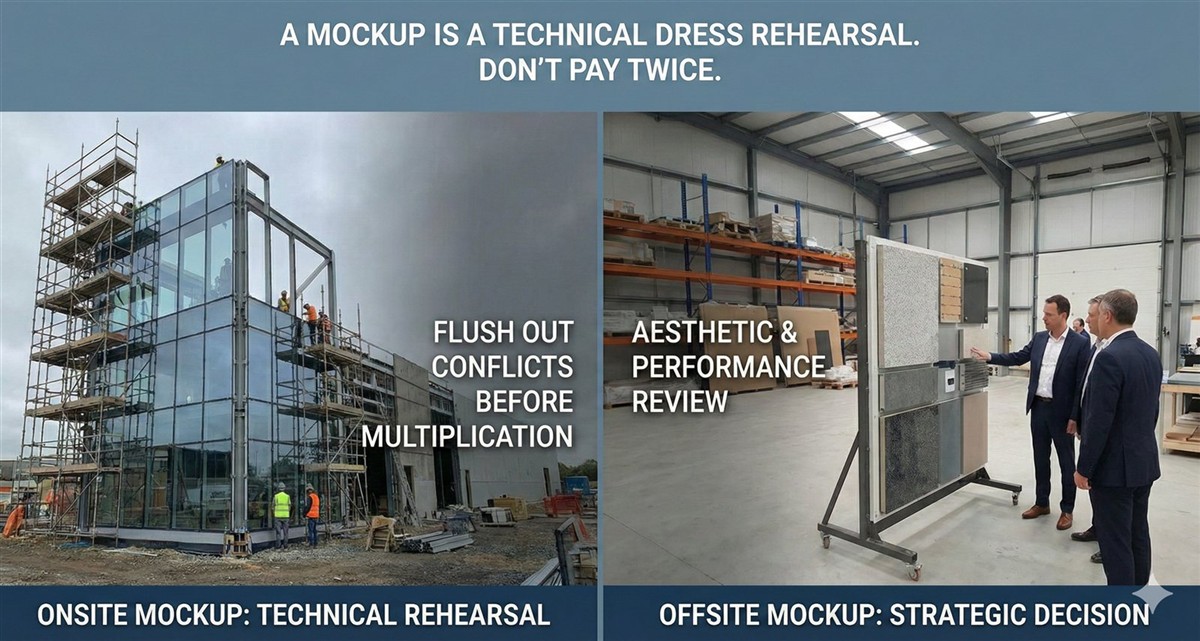
Mockups are the insurance policy against the "Malevolent Hiding Hand" of construction. They represent a controlled environment where the Owner, the Architect, and the General Contractor can fail safely, cheaply, and early. The question isn’t whether to build a mockup—it’s where to put it to maximize risk mitigation.
The Onsite Mockup: Testing the Reality of the Field
An onsite mockup is typically built on the project grounds, often in a corner of the site that won't interfere with the main footprint. This is the "mud-level" reality check.
Trade Sequencing and "First-Run" Studies: The primary value of an onsite mockup is the human element. The same foremen and crews who will build the tower should build the mockup. This is where the team discovers that the HVAC ducting won’t clear the structural steel as designed, or that the waterproofing detail requires a sequence that the subs hadn't budgeted for.
Environmental Context: Onsite mockups are subjected to the actual environment of the project—the same wind loads, sun angles, and humidity. If a curtain wall system is going to weep or a sealant is going to fail, it’s better to see it happen in the local climate.
The Logistical Footprint: The downside of onsite mockups is space. On tight urban sites, a full-scale mockup is a logistical nightmare. It competes with laydown areas and crane radii. If the mockup is "in the way," it becomes a rushed job, which defeats the purpose. A mockup built in haste will hide the very defects it was meant to reveal.
The Offsite (Out-of-Sight) Mockup: The Controlled Laboratory
Offsite mockups are often built at a third-party testing facility or a dedicated warehouse. These are common for complex façade systems or high-end interior finishes (like a luxury hotel guestroom).
Performance Verification Testing (PVT): If the risk is technical—such as air infiltration, water penetration, or seismic movement—the mockup must be offsite at a certified lab. You cannot simulate a 100-mph wind-driven rainstorm on a jobsite without risking the rest of the project. For high-performance skins, the offsite mockup is a mandatory gate-check before the fabrication approvals are finalized.
Early Executive Approval: Offsite mockups allow the "suits" to make decisions months before the site is ready. For a developer, seeing a fully finished "room-in-a-box" in a warehouse allows for board-level sign-off on finishes, lighting, and operational factors while the foundation is still being poured.
The "Lab Condition" Bias: The risk of offsite mockups is that they are too perfect. They are built by "A-teams" in climate-controlled warehouses. They don't account for the wind, the dust, or the 3:00 PM fatigue of a jobsite in February. An offsite mockup proves a design can work; it doesn't prove it will work when built at scale by a standard crew.
The "Limit of Acceptable" Standard
Regardless of location, the mockup’s most critical function for the Owner is establishing the "Quality Benchmark."
Beyond the RFI: Construction contracts are often vague on "workmanship." A mockup turns "industry standard" into a physical reality. It defines exactly what is acceptable regarding grout lines, weld quality, and material transitions.
The "Golden Unit": Once approved, the mockup becomes the "Golden Unit." If the work on the 20th floor doesn't match the mockup, the Owner has a contractual stick to demand rework. Without a mockup, "quality" is a subjective argument that the Owner usually loses.
Sign-Off Rigor: Every major trade must sign off on the mockup. The waterproofing sub must sign that they can seal to the window frame; the glazier must sign that the frame is compatible with their glass. This eliminates the "finger-pointing" that occurs when a leak is discovered three years later.
Constructability: Killing the "Paper Hero"
Architects are often "paper heroes"—they design details that look beautiful in CAD but are physically impossible to build with a standard wrench or trowel.
Identifying Technical Debt: A mockup reveals "technical debt"—design choices that are so complex they invite human error. If a mockup shows that a detail requires an 8-step process with three different trades overlapping in a 6-inch space, the Owner should demand a redesign.
Schedule Integrity: By perfecting the sequence on the mockup, the GC can develop a realistic "burn rate" for the main build. If it takes three weeks to build one bay of the mockup, the 40-week façade schedule is a fantasy. The mockup provides the data to anchor the schedule in reality.
"So What?" (Strategic Consequences)
Financial Impact: A mockup typically costs between 0.5% and 1% of the total construction cost. Rework on a major system during the main build can easily exceed 5% to 10% of the cost, plus the "soft costs" of delay and litigation.
Risk Mitigation: The mockup is the only place where "trial and error" is profitable. In the main build, "trial and error" is called a change order.
Asset Performance: For an Owner, the TCO of a building is heavily influenced by the envelope. A mockup ensures the envelope is airtight and watertight, protecting the long-term value of the asset from mold, rot, and energy loss.
The Bottom Line
A project without a mockup is a project that is being "beta-tested" at full scale. No Owner should ever accept being a test subject for an unproven design or an uncoordinated trade sequence.
Build the mockup onsite if you need to train the crews and test the schedule. Build it offsite if you need to verify technical performance or get executive buy-in early. But whatever you do, build it. If you think the mockup is expensive, wait until you see the bill for the forensic engineer who has to explain why the building is leaking five years from now.
Actionable Strategy for Owners:
Identify the "High-Risk 10%": Don't mockup everything. Focus on the 10% of the building that is most likely to fail or cause a delay (façade transitions, complex MEP clusters, typical units).
Mandate the "Golden Unit": Ensure the contract states that the mockup is the binding standard for all subsequent work.
Watch the Crews: If the GC sends their "specialists" to build the mockup instead of the regular crew, the mockup is a lie. Demand that the mockup be built by the actual project team.
Budget for Failure: Expect the first version of the mockup to fail. That is its job. If the mockup is perfect on day one, you probably didn't look closely enough.