The switchgear was approved and on the schedule, with a delivery date nobody was watching anymore. Then it slipped. Nothing was wrong with the order or the drawings. The trade had better work somewhere else, and the Owner's job slid down its list.
A few weeks of electrical delay never stays a few weeks. Energization waits on the gear, testing and inspections wait on energization, and the finishes stack up behind all of it until the whole project is months late.
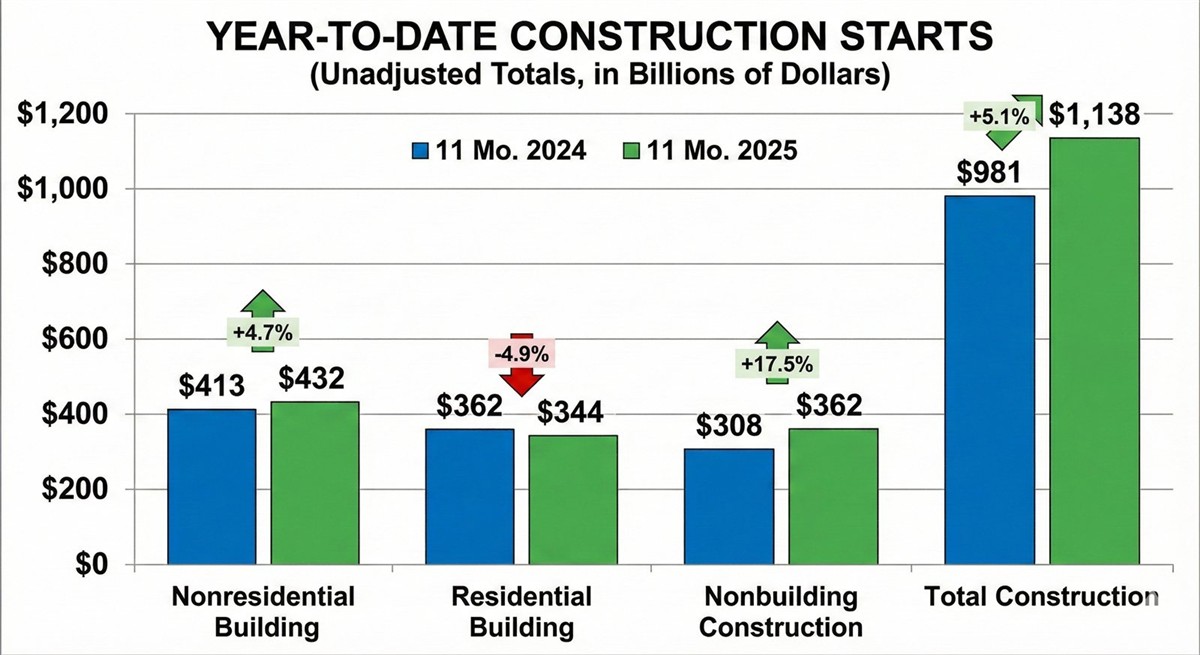
National construction numbers say owners should have the upper hand right now. Total spending fell 2.7% year over year in September. Take out data centers and power, and private nonresidential work fell 7.8%, according to AGC's read of the Census data.
That is not what an owner sees when the electrical bids come in. The general market is cooling. The market for electricians, pipefitters and switchgear is not, because the one sector still growing runs on exactly those things.
Everything Else Shrank
Data center construction spending was up 90% year over year in September. AGC says data centers and electric power accounted for all of the private nonresidential gains.
The backlog data shows where the capacity went. ABC members with data center work are carrying 11.3 months of backlog, three months more than firms without it, and only 15% of ABC members have that work at all. That 15% is not a random slice of the industry. It leans toward the MEP firms with the deepest benches, and those firms are not hungry. They are choosing.
Algorithms Don't Pull Wire made the point that the AI build-out moves at the pace of a journeyman electrician. The follow-up is less comfortable for everyone else. That same journeyman is the one a hospital wing or a university lab needs next spring.
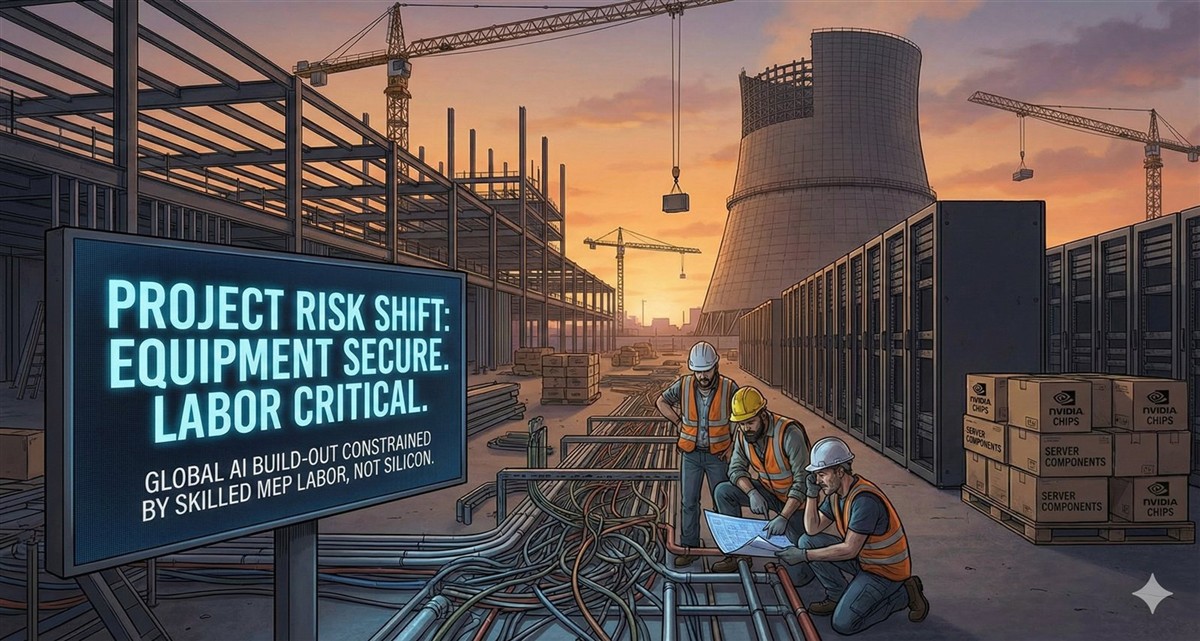
EPRI's Andrew Maxson told Utility Dive in September that skilled labor shortages have become a binding constraint on data center development, on par with land, permitting and power. Data centers are competing with semiconductor plants, battery plants and power generation projects for electricians and pipefitters, in the same regions and during the same construction windows.
An institutional owner is in that fight whether it knows it or not. The hyperscaler on the other side measures delay in lost compute revenue. A labor premium that would sink a capital budget barely registers on theirs.
Some owners will read the softer data center numbers as relief. Goldman Sachs estimated in May that only 50% to 60% of planned data center capacity will come online as expected over the next two years. Dodge reports commercial planning down 17.6% year over year through October, which it ties to weaker data center and warehouse planning.
A boom that stalls and restarts is harder to plan around than a steady one. Crews follow the work, and when the work moves in fits, the crew counted on in March can be somewhere else by May.
A Schedule Is Not a Delivery Slot
Fluxco says the typical customer now waits two to three years for a standard power transformer, and it doesn't expect that to improve before 2027. The medium-voltage equipment for an institutional building comes out of the same strained supply chain.
A schedule that shows gear arriving when the electrical sub needs it is a work of fiction until a manufacturer confirms the slot.
The Hospital Wing Bids Last
Dodge has institutional planning up 33.4% year over year through October. The largest institutional projects entering planning last month included a $336 million medical campus in Fairfield, California, and a $257 million acute care building in Cornelius, North Carolina.
Hospitals, labs and research buildings are about as MEP-heavy as construction gets. A wave of them is heading into design now, and by the time they bid, the crews and the gear will already be spoken for.
The owner most exposed is the one running the standard sequence: finish CDs, bid, sign the GMP, then let the GC buy gear and the electrical sub staff the job. In this market the sub with the deepest bench may not bid at all. The package goes to the next firm down, often one taking on more than it has ever carried. Nobody sees the problem at award. It shows up at peak manpower.
When the switchgear slips, the TCO and occupancy slip with it, and every week of that is carry and extended general conditions.
For institutions it is worse. A research building that misses the start of a semester can sit underused for most of a year. A clinical building that misses its opening date drags every program and hire tied to it.
Before the GMP Is Signed
Nobody outbids a data center. An owner can out-plan one, and most of the moves happen before the GMP is signed.
Buy the long-lead electrical gear directly. Release switchgear, transformers and generators for owner procurement at the end of design development and assign them to the contractor later. That puts procurement risk on the owner, but the owner already carries the delay risk.
Prequalify MEP subs on what they have committed, not what they have built. Ask for current backlog across every job, peak manpower during the project window, and the foreman's name. The firm with data center work may be the most qualified bidder in the room and the least available.
Get the trades under contract before design is done, through design-assist or early trade packages. A signed agreement holds a place in a sub's manpower plan. A bid invitation six months out holds nothing.
Write manpower into the contract. Named supervision and minimum crew levels at defined milestones won't put bodies on site by themselves, but they give the owner a record when recovery starts.
Build the schedule backward from confirmed gear dates and carry the float there, not spread across the finishes.
Contractors have one job in all this: tell the owner early when the bench can't cover the window. The subs who say so get remembered. So do the ones who say yes and send half a crew.
The data center down the road is not going to slow down so a hospital can staff its electrical package. Ownership has to get there first.
Sources: Associated General Contractors of America analysis of U.S. Census Bureau construction spending data, September 2026 (via EFCG Weekly Briefing, Nov. 6, 2026); Associated Builders and Contractors Construction Backlog Indicator and member data (via Construction Dive, Nov. 6, 2026); Dodge Construction Network Momentum Index, October 2026 (via Construction Dive, Nov. 9, 2026); EPRI, Fluxco and Goldman Sachs (via Utility Dive, Sept. 29, 2026).