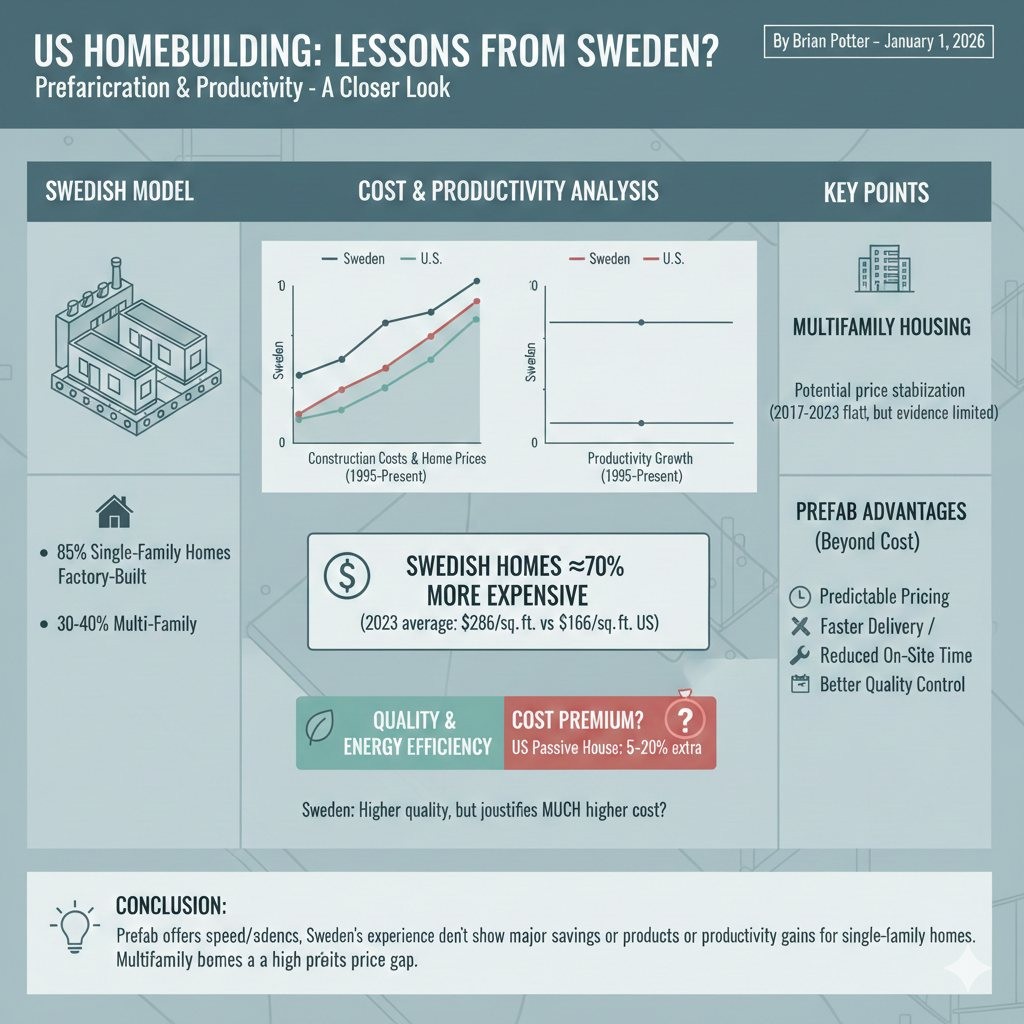
Many advocates for improving U.S. homebuilding suggest emulating Sweden’s widespread use of prefabricated construction. In Sweden, about 85% of single-family homes and 30–40% of multifamily buildings are factory-built. The theory is that moving construction off-site into factories could improve productivity and reduce costs in the U.S. However, the author argues that evidence from Sweden does not strongly support this claim, especially for single-family homes.
Key Points:
1. Prefabrication in Sweden
Sweden has large-scale adoption of prefab housing, with impressive factories like Lindbäcks.
Advocates believe this model could solve U.S. housing inefficiencies.
2. Cost and Productivity Analysis
Swedish government data shows construction costs and home prices have risen faster than inflation, similar to the U.S.
Since 1995, Swedish construction costs have grown at about the same rate as U.S. costs, but Swedish home prices have risen much faster.
Productivity growth in Swedish construction has been stagnant since the mid-1990s, despite increased prefab adoption.
Swedish homes cost significantly more:
2023 average: $286 per sq. ft. vs. $166 per sq. ft. in the U.S. (≈70% higher).
3. Quality and Energy Efficiency
Swedish homes are more energy-efficient than U.S. homes.
Some argue higher costs reflect better quality and efficiency.
However, the author notes that factory-built housing should deliver both quality and cost savings, not trade one for the other.
Passive House standards in the U.S. show that high energy efficiency can be achieved with only a 5–20% cost premium, far less than the Swedish price gap.
4. Multifamily Housing
Evidence suggests prefab may help stabilize multifamily prices (flat between 2017–2023), but benefits remain uncertain.
Exchange rates and other factors complicate analysis.
5. Advantages of Prefab Beyond Cost
Predictable pricing and faster delivery.
Reduced on-site time, useful in harsh climates.
Better quality control and fewer last-minute changes.
Conclusion:
Prefabrication offers benefits like speed and predictability, but Sweden’s experience does not show major cost savings or productivity gains, especially for single-family homes.
Multifamily housing may see some benefits, but evidence is limited.
Swedish homes are higher quality and more energy-efficient, but this does not fully justify the much higher costs compared to U.S. homes.
Check out Brian Poter's Should US homebuilders emulate Sweden? - by Brian Potter