The Price of Friction: Governance as a Risk Mitigation Tool
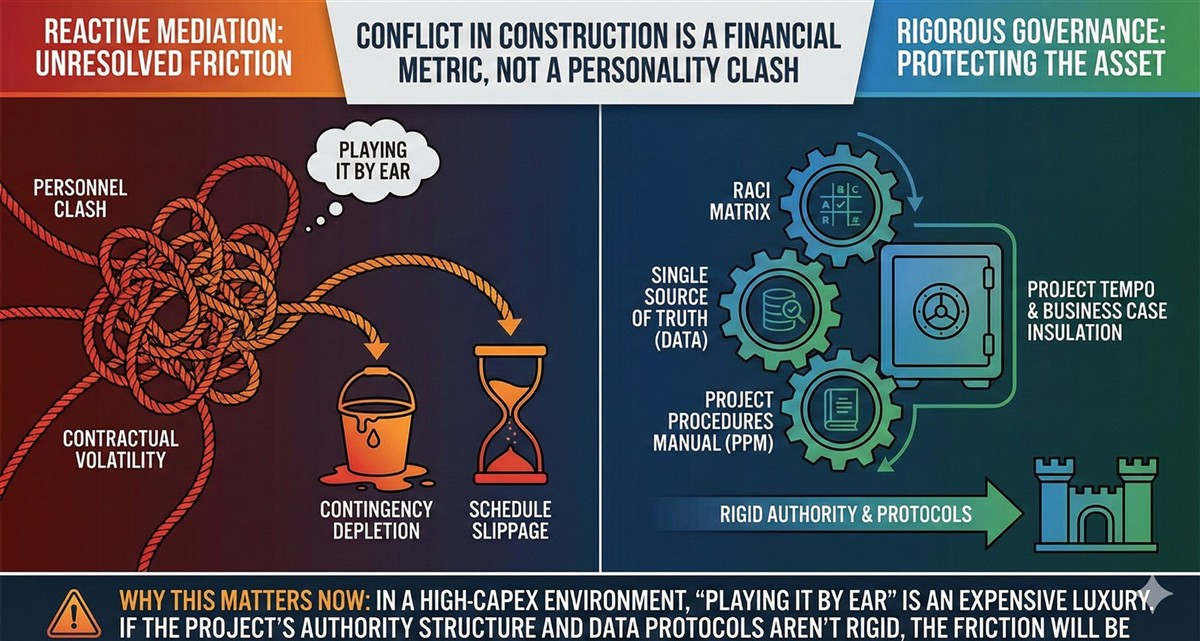
Conflict in construction is rarely about personalities. It is the predictable friction caused by murky authority, asymmetric data, and unmanaged expectations. For an Owner, unresolved friction is a financial leak that erodes the business case through contingency depletion and schedule slippage. Protecting the asset requires a transition from reactive mediation to rigorous governance—using a disciplined framework of accountability and a single source of truth to maintain project tempo.
The Architecture of Alignment: Governance over Hope
Conflict often stems from a lack of clarity established long before the first shovel hits the ground. Ownership must move past "magical thinking"—the hope that a talented team will simply "figure it out"—and implement a disciplined framework for project governance.
The RACI Matrix as a Shield: Project paralysis occurs when authority is murky. A comprehensive Responsibility Assignment Matrix (RACI) must document every task and level of authority. This prevents "who’s in charge" disputes during critical path moments. If the team cannot identify who is Responsible, Accountable, Consulted, and Informed for a specific RFI (Request for Information) or Change Order, the process will stall.
The Project Procedures Manual (PPM): This is the project’s constitution. It defines stakeholder interactions, communication protocols, and quality standards. Without a clear "rulebook," every dispute becomes an improvisational exercise that costs the Owner time and money.
Neutralizing Stale Data: Disputes over inconsistent information are self-inflicted wounds. Utilizing a Management Information System (MIS) and BIM (Building Information Modeling) ensures all parties have real-time access to the same budget and schedule data. When the field and the boardroom look at a single source of truth, the opportunity for data-driven conflict evaporates.
Common Fault Lines: Identifying Recurring Failure Modes
Even with robust systems, specific failure modes recur. Addressing these requires a stoic, practical approach focused on outcomes, not ego.
Resource Allocation and Transparency: Tensions mount when trades perceive preferential treatment regarding site access, labor, or equipment. The solution is radical transparency—regular coordination meetings to discuss resource distribution and an open-door policy for voicing concerns before they turn into site-level standoffs.
Scope Creep and the Change Order Trap: Inadequate documentation leads to technical debt and legal disputes. Every modification to the GMP (Guaranteed Maximum Price) or the base scope must require written direction and go through a formal control-scope process. If the work isn't in writing, the work shouldn't happen.
Contractual Interpretations: Misunderstandings regarding "means and methods" or payment schedules can stall progress. A joint review of contracts before execution ensures all parties understand their mutual obligations. The goal is to eliminate surprises that lead to a work stoppage.
Strategic Escalation: Protecting the Asset
When professional composure fails and a stakeholder group refuses to cooperate, Ownership must prioritize project health over individual relationships.
Dispute Review Boards (DRB): Establishing a DRB at the outset provides a neutral test of positions. This facilitates settlement without the scorched-earth impact of full-scale litigation. It allows for a technical solution to a technical problem.
Empowering Project Leadership: Project Managers must be empowered with the authority to enforce procedures. A PM without authority is just an expensive secretary.
The Nuclear Option (Termination): In extreme cases, terminating a contract is a risky but necessary step to preserve the investment. This is a last resort, triggered only when performance becomes a terminal risk to the schedule or site safety.
"So What?"
Unresolved conflict is an expensive luxury that no project pro forma can afford.
Financial Impact: Erosion of the project value through legal fees, interest carrying costs, and the loss of efficiency that follows a fractured team.
Schedule Risk: Every day spent in a boardroom arguing over a scope gap is a day lost on the critical path. These missed milestones trigger liquidated damages and delay the occupancy that the business case depends on.
Personnel Implications: High-performing teams flee toxic environments. If a site becomes a battlefield, the Owner will eventually be left with the "B-Team," leading to quality issues and further delays.
The Bottom Line
A project is an orchestra, and the Owner is the financier who chose the piece. You don't need to play every instrument, but you must ensure the conductor has the authority to keep the musicians in tempo. Construction is too expensive for personality-driven management. If the governance isn't rigid, the friction will be.
The cost of being "nice" is often found in the litigation phase; the cost of being clear is a project delivered on time.
Would you like me to draft a high-impact LinkedIn post based on the "Architecture of Alignment" section of this article?